Thursday, December 18, 2014

Mumps on ice

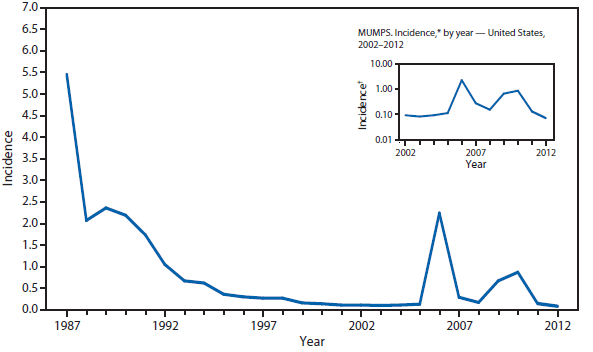
This figure is a line graph that presents the incidence per 100,000 population of mumps cases in the United States from 1987 to 2012The mumps vaccine was licensed in the US in 1967 and recommendations regarding use of the vaccine have varied since its introduction. As described in the CDC Manual for the Surveillance of Vaccine-Preventable Diseases, the Advisory Committee on Immunization Practices (ACIP)
made an official recommendation for one dose of mumps vaccine for all children at any age after 12 months in 1977. In 1989, children began receiving two doses of mumps vaccine because of the implementation of a two-dose measles vaccination policy using the combined measles, mumps, and rubella vaccine (MMR) vaccine. In 2006, a two-dose mumps vaccine policy was recommended for school-aged children, students at post high school educational institutions, healthcare personnel, and international travelers.
Mumps vaccine has had a profound impact on the annual incidence of mumps in the US. In 1968 more than 152,000 cases reported, while in 2003 only 231 cases were reported. Recently, however, the nation has witnessed a resurgence of the disease, and an apparently ongoing outbreak of mumps in the National Hockey League (NHL) illustrates how the mumps virus continues to circulate in the general population. The NHL outbreak has, so far, affected 15 players on five teams, and another three cases are suspected. A timeline of events surrounding the cases suggests the outbreak originated in October.

Doni Bloomfield wrote an article this week (which also contains "mumps on ice" in the title) that, in one vivid passage, illustrates potential infection pathways for mumps virus in professional hockey. Bloomfield quotes James Conway of the University of Wisconsin School of Medicine and Public Health:
You watch these guys taking a big hit up against the boards, there’s snot and boogers and all sorts of stuff flying around as the guy gets hit hard enough, so I don’t think it would surprise me at all that there’s some transmission just by stuff flying around during the games. It’s a sloppy, messy sport.
That's colorful imagery for sure, but in addition to how, it's important to ask why this and other recent outbreaks are occurring. Mumps is, after all, a vaccine preventable disease. 

It's possible that this group of players belongs to a demographic that has lower vaccine coverage, potentially due to parental reticence to vaccinate. However, at least one player is known to have had two doses of vaccine: one childhood dose, consistent with ACIP guidelines in the late 1980s, and another in preparation for foreign travel in February of 2014. Tara Haelle wrote an article recently on the mumps vaccine in which she quotes Paul Offit discussing the rate of waning immunity associated with this vaccine. Offit notes that
If you look at the three [MMR component] vaccines, measles and rubella induce larger memory in B and T cells . . . They have longer lasting immunity. Mumps is the weak sister of the three. You start to see vulnerability 10 years after the first dose and 10 years after the second dose.
Waning vaccine-associated immunity could thus play a role in this outbreak, and in potential future ones as well. Boosters have been used to compensate for waning immunity in past mumps outbreaks. Might a third dose of vaccine be appropriate for the general population at some point in the future?

(image source: CDC)

Thursday, December 4, 2014

The epidemiology of Fearbola

In the mid-19th Century, a newspaper could reach several thousand people daily or weekly. By the mid-20th Century, TV and radio reached 10s to 100s of millions of people instantaneously and possessed a multinational reach. Today, with the Internet, and satellite TV and radio, it is possible to reach 100s of millions of people or more across the globe within minutes. This vast and practically instantaneous reach of technology feeds a seemingly insatiable, 24/7 appetite for news and information. What are the implications of this for fighting epidemics? 

We've seen some of the consequences in the Ebola outbreak this year. On the one hand, the ability of aid groups to spread information broadly has been helpful for raising awareness and bringing additional resources to bear on the epidemic. On the other hand, news headlines resulted in near-hysteria and much counterproductive behavior in the US and other developed nations. Examples were highlighted in a previous post, and many, many others have offered similar observations and commentary.

Perhaps the reactions observed in the US have been understandable, as many ingredients were present for an epidemic of sensationalism and fear: An active public imagination rooted in previous popular books and movies, a government that addressed the issue late and with almost Pollyannaish credibility at first, and a wealth of news outlets offering non-expert commentary while playing to the continuous news cycle.

The resulting epidemic of "Fearbola" should thus not be surprising. It is sobering, however, for it provides a warning for domestic public health agencies: Understand how to administer effective public health messages that are relevant and appealing to the constant clamor of CNN, Fox, and the like, or else risk being drowned out by noise and hype. What if this epidemic had been of a pathogen possessing a short serial interval and high virulence, transmissibility, and R0? The medical system may or may not be prepared, but it seems clear that our risk communication strategies are not. Would the news coverage we saw during the Ebola hysteria in recent months have served the public well if this had been a bona fide threat to US public health?

It's important to understand how the epidemic of fear and hype came into being and propagated so well. I tend to think of messages as themselves being infectious. From that perspective, the ideas that resulted in the hysteria surely had R0 > 1. For ideas related to "dread threats", such as virulent infections with no known cure, is this unavoidable given the high contact rate (e.g., frequency of checking for news and rumors combined with near-constant coverage), short serial internal (e.g., rush to post on social media), broad coverage, and rapid dissemination of modern communications?

If so, we must learn how to craft public health messaging strategies so that authoritative messages will out-compete hype and fear in our hyper-connected world. If we don't learn how to do so, we run the risk that important messages will be drowned out by high-incidence, fearful messages in future outbreaks of international public health importance.

(image source: David Hartley)

Saturday, November 22, 2014

Ebola: Encouraging news but far from victory

The Ebola treatment unit (ETU) in Tubmanburg is the first ETU to be built and staffed by the United States in Liberia / Carol Han, USAID/OFDARecent statistics from West Africa suggest that the epidemic of Ebola virus disease is declining in some areas. While this is welcomed and good news, it's important to remind ourselves that the public health emergency is not over and that significant uncertainties remain. Dr. Joanne Liu, the current president of MSF, described the reasons in an interview with Julia Belluz:
Strictly speaking, when we look at our figures, there is deceleration in the number of cases in a few spots in Liberia and Guinea, but they are still on the rise in Sierra Leone.

There are a few things we need to be conscious about: we have had those decelerations in the past. Basically, it happened while it was spreading in other communities and after that, there was another surge in other hot spots. So we need to make sure it’s an opportunity to consolidate our Ebola isolation centers and case management, strengthen the community information and education. That is key. We need to use this time for that. But the main thing is to not let down our guard.

There’s no room for complacency, no room for mistakes. Every time you go down that path, you pay: you get infected, more people are infected. Ebola does not allow you to make mistakes.
This is certainly true. I think it's also a critical time in another way: With the medical aid in the region and the momentum it is gaining, it would be a shame not to begin asking what will happen when the epidemic is finally conquered. Will the international community simply pull out, leaving a vacuum made more acute by the scores of local healthcare workers lost to Ebola itself? Or, is there a way that the current activity could bolster and influence medicine and public health there for years to come? Some ideas may be creeping into the conversation: US and Liberian officials have decided to reduce the number of Ebola treatment units planned and are discussing spending the money saved on programs aimed at combating future epidemics.

For now, however, we must avoid complacency and remain committed to providing the resources needed to fight the ongoing epidemic. I don't think it's too early to begin conceiving a foundation for improving regional medical and public health capabilities more broadly, however. Perhaps some of the capabilities on site in the affected areas now can be transitioned into a sustainable, effective medical and public health presence at the appropriate time. Not doing so would be a missed opportunity.

(image source: USAID/ Carol Han)

Thursday, November 13, 2014

Influenza vaccine recommendations: Stop needling me!

File:14234CDC Flumist.tifSeasonal influenza is responsible for an estimated 200,000 hospitalizations and 23,000 deaths in the US annually. Each year influenza vaccines are produced based on the viruses forecast to become prevalent. There are two types of vaccine: inactivated influenza vaccine (IIV), delivered via injection, and live attenuated influenza vaccine (LAIV), delivered via a mist sprayed into the nose. Influenza vaccines typically have efficacies exceeding 60% and an estimated 46% of the American public relieves vaccine annually.

While many people are vaccinated each year, it is desirable to increase vaccination rates for at least two reasons. First, vaccine-associated immunity protects individuals from developing potentially serious or fatal disease. Second, high population coverage produces a herd immunity effect: those possessing vaccine-associated immunity cannot become infected and thus cannot infect others. This is especially important for protecting individuals for whom vaccines are contraindicated.

Individuals who are immunocompromised or immunosuppressed are such a group. Consider, for example, patients recovering from hematopoietic stem cell transplantation (HSCT) following myeloablative conditioning. In cases of imperfect donor-recipient match, patients may take immunosuppressive medications as prophylaxis against, or treatment for, graft versus host disease. During this process of immunologic tolerization, which can last months or longer, patients must avoid crowds and limit work/school and social interactions in order to avoid potentially fatal infections. And during this period it is critically important for caregivers and contacts to be vaccinated against influenza and other vaccine-preventable diseases so that they do not become infectious.

LAIV is contraindicated for caregivers of such persons in the Advisory Committee on Immunization Practices (ACIP) guidelines. Because LAIV contains live influenza viruses, a potential exists for transmission of vaccine strain viruses from vaccinees to other persons. The period of viral shedding in vaccinees is variable and relatively short lived. Vaccinated immunocompetent children, for example, shed vaccine viruses for less than 3 weeks, and evidence suggests that shedding may be much shorter lived than that. LAIV-associated shedding occurs in lower titers than is typically observed in disease-associated shedding caused by wild-type influenza viruses.

As several studies have demonstrated higher efficacy of LAIV relative to IIV in children (but see the footnote below), the ACIP has expressed
a preference for the use, when immediately available, of live attenuated influenza vaccine (LAIV) for healthy children aged 2 through 8 years, to be implemented as feasible for the 2014–15 season but not later than the 2015–16 season.
Higher protective efficacy of LAIV in children provides strong rationale for the ACIP statement. Moreover, promoting LAIV as an alternative to IIV in older patient populations may result in increased coverage in those who avoid vaccination due to fear of needles. I wonder if increased use of LAIV might pose additional risk to immunocompromised persons, however, in terms of inadvertent exposure to recent vaccinees shedding live, though attenuated, influenza viruses. Such patients may need to become more meticulous in screening visitors and contacts who may have received LAIV recently.

Footnote: During 2013-2014 there was no measurable effectiveness for LAIV against influenza A (H1N1) among children enrolled in effectiveness studies. The reasons for this are unclear.

(image source: Wikipedia)

Thursday, October 30, 2014

Planning for the unplannable: What about next time?

A recent article in Forbes, written by Scott Gottlieb, began by observing that
The response by public health officials and local providers to the first case of Ebola diagnosed on U.S. soil has been marked by some tragic missteps. Mistakes have resulted in the avoidable secondary spread of the infection to healthcare workers. This is an appalling outcome to a crisis . . . But, sadly, it should neither be surprising, nor foretell a future marked by continued blunders.
As he suggests, I'd really like to think that the response to the events in Dallas will result in better ED and hospital care. It's important to learn from errors, and this seems to be happening: There's been a dramatic increase in infection control awareness since late September.

That seems like a good thing, but there's more to the picture. Alison Bruzek wrote an interesting piece for NPR last week on how, for hospitals, doing more on Ebola can mean less elsewhere. A passage from the article illustrates the point:
For infection preventionists, a normal routine includes "Looking at the lab results[.] [W]e're looking at what new patients maybe came onto a unit, we're taking calls from the unit, [and answering questions like] 'What do you think I should do about this particular thing?'" says Linda Greene, an infection prevention manager and member of APIC's regulatory review panel. But now, Green says, if the infection preventionist is working on training with personal protective equipment for Ebola, their other tasks aren't getting done as promptly or efficiently as they could be. As a result, Greene [says] the fear is that they'll "miss red flags" for patients with the flu or antibiotic-resistant bacteria.
How can this be avoided? It's difficult for many reasons, including that hospitals, financially speaking, are zero sum propositions: Annual budgets govern allowances for departments. A previous blog discussed the trade off between different infection prevention activities given a constant budget through a fictional story. Bruzek's article highlights how focus here might lead to shortcomings there, all things being equal (i.e., budgets and resources being constant), in a real situation.

One might think that hospitals should simply do a better job of planning for contingencies like the Ebola preparations in which they are now engaged. Perhaps they could, but it's not necessarily simple; budgetary contingencies are usually for things that are random but can be conceived and planned for. Nobody forecast this Ebola event or the implications for US healthcare, and no hospital could rightly be expected to have included Ebola preparations in their fiscal year planning.

Moreover, this situation may have been unplannable. While analyses of public health threats, including bioterrorism, have considered a broad range of issues, I don't have the sense that anyone truly anticipated the extent of the hospital, media, or political issues encountered in the US recently. Nonetheless, the need to prepare for complex unexpected events cannot be denied.

So how do we plan for the unplannable? To address the issues mentioned in Bruzek's article would require specialized human resources and the funds to engage them on a surge basis, in addition to money for PPE. Planning for the availability of such human, material, and financial resources is not easy when they are required randomly, rarely, and -- as in this case -- widely. It's important for public health researchers, professional organizations, and trade groups to study and address such issues, because if there's one thing nature has taught us, it is that there will be a next time.

Thursday, October 23, 2014

Fearbola

File:Expression of the Emotions Figure 20.pngSome people in the US have absolutely panicked over the threat of Ebola at home. To cite but a few examples:
  • A Portland, Oregon, high school canceled a visit by African students, citing concerns about Ebola. The 18 visiting students came from Republic of Congo, Niger and Ivory Coast, none of which currently have reported cases of Ebola, according to the WHO.
  • Two children who recently moved to the US from Rwanda are being kept home from school after parents at an elementary school in New Jersey voiced concerns. Rwanda is in East Africa, over 2,500 miles from the West African areas where Ebola virus is currently circulating.
  • An assistant principal at a North Carolina middle school has to spend 21 days working from home when she returns from a mission trip to South Africa, by order of the school board. The chairperson of the school board explained why: "It’s not that we think that she poses any type of risk, but it's public perception here that we're concerned about.
More examples are described in a recent CNN article, which also notes that:
This is getting ridiculous. While the threat of Ebola is very real in Africa, the paranoia it's generated in the United States is unreal.
Many baseless actions are being taken out of "an abundance of caution", and it's not only in the US: A recent article by Andrew Higgins describes similar behavior in Europe.

While listening to the radio while working today, it struck me how someone having a case of air sickness on a commercial jetliner now makes the national news. Perception of risk is a notoriously sticky subject, but perhaps it's a good time to begin a conversation on how to educate people better on the topic. Could some basic elements of risk assessment be taught, for example, in high school?

(image source: Wikipedia)

Saturday, October 18, 2014

Fear, Ebola, and the plague doctor's outfit

An earlier post mused that, in some ways, modern healthcare workers in contact precautions might appear as the plague doctors did in the Middle Ages to their febrile, terrified patients. The imagery of the plague doctor's outfit has survived centuries in association with a horrific event responsible for significant death and social disruption. Today, the doctor's outfit remains a powerful symbol of desperate times.

While the current epidemic of Ebola virus disease is unlikely to have the depopulating effect that plague did in the 1300s -- the Black Death is estimated to have killed up to 60% of the European population at the time -- the deadliness of this virus as it circulates in Western Africa must produce a fear similar to that of the Black Death in the Middle Ages. It makes me wonder if, years from now, pictures of doctors and nurses in Ebola personal protective equipment (PPE) -- the garb healthcare workers must wear to care for patients -- will conjure up similar reactions to those of the plague doctor's outfit.

Think of the similarities. If the case fatality rate (CFR) of plague in the 14th Century was similar to that of plague in the US between 1900 and 1941 (i.e., in the pre-antibiotic era), the CFR of the Black Death could have been over 60%. The CFR of Ebola in West Africa is currently estimated to be near 70%. Probably due to this high CFR during the Black Death, people were often deeply skeptical of doctors, as as Giovanni Boccaccio  describes in The Decameron:
Which maladies seemed set entirely at naught both the art of the physician and the virtue of physic; indeed, whether it was that the disorder was of a nature to defy such treatment, or that the physicians were at fault - besides the qualified there was now a multitude both of men and of women who practiced without having received the slightest tincture of medical science - and, being in ignorance of its source, failed to apply the proper remedies; in either case, not merely were those that covered few, but almost all within three days from the appearance of the said symptoms, sooner or later, died, and in most cases without any fever or other attendant malady . . . 
As we have read in this event, distrust of healthcare workers in Western Africa has led to attacks on doctors, though this sentiment may partially stem from historical events. Indeed, serious issues with healthcare in this region are nothing new.

Of course, there are important differences between bubonic plague in the Middle Ages and Ebola in Africa today as well. Plague is caused by a bacterium whereas Ebola virus disease has a viral etiology; Yersinia pestis is carried by domestic rodents and vectored to humans by fleas whereas Ebola virus is directly transmitted between humans; et cetera. Perception is reality, however, and one overarching public perception is proving a difficult to alter: Ebola is terrifying. Ebola PPE is a modern plague doctor's suit, a tangible symbol of fear, a fear that we have but to turn on any newscast to see spread.

I feel strongly that we must never forget the human dimensions of disease. Physiologically speaking, Ebola virus disease in Homo sapiens is increasingly well understood, but the impact of the disease on the human condition is perhaps less so. If we are to control the spread of Ebola virus, we must understand this better; it seems clear that we don't. Fear and panic only make the situation worse. We must control the fear.

(image source: Wikipedia and WHO)