Showing posts with label analytics. Show all posts

Tuesday, May 12, 2015

Intensive care from afar: Caregiver versus patient watcher

File:US Navy 030423-N-6967M-090 A central computer system monitors the heart rates of each patient in the Intensive Care Unit (ICU) to ensure a quick.jpgA recent NPR story by Michael Tomsic recounted the remarkable story of how the Carolinas HealthCare System monitors ICU patients in 10 of its hospitals from a remote "command center"-like facility. Several critical care specialists staff the center; nurses are present around the clock and doctors work nights. Command center staff also spend time at the hospitals they monitor.

The system began doing this roughly two years ago and have since found that the quiet atmosphere of the command center ("none of the bells and whistles going off that most ICUs need to alert nurses and doctors down the hall that they're needed") allows medical staff in the center to maintain a constant focus on patients. The approach seems to be working for the system: They've observed a higher patient volume, lower mortality rate, and decreased length of stay since opening the center (though, as the article describes, such improvement likely isn't due solely to the remote monitoring program).

The issue of alarm fatigue is recognized as an important patient safety issue, so the idea of placing a group of specialists outside the immediate patient environment for monitoring purposes has a strong rationale. What I found most interesting about the article, however, was revealed in remarks from two nurses interviewed. One observed that "There are things that I'm able to view here [in the command center] — trends that I'm able to view here — that I'm not able to view at the bedside", while another noted that since the command center staff has easy access to patient data, handoffs are better and issues are less likely to be missed.

Assuming that these ICUs are not fundamentally different from ICUs in other facilities, the story highlights an issue that is endemic far beyond this particular set of hospitals: the frequent failure to bring data to the bedside in an effective way. This is ironic, as the big data and IT revolution brags -- incessantly, it sometimes seems -- about delivering data and analytics to the point where they can be most useful. That isn't consistent with the remarks from healthcare workers in this article.

Is caregiving versus patient monitoring an either-or proposition? I doubt it, as I've seen data-driven intensive care delivered reliably over long periods of time. Rather, I think the question is how to make data actionable through delivery to the right people without disrupting their workflow. It's a question for all clinical environments beyond the ICU. We need to make more effective use of routine clinical data.

(image source: Wikipedia)

Saturday, April 4, 2015

The information tsunami: Riding versus drowning

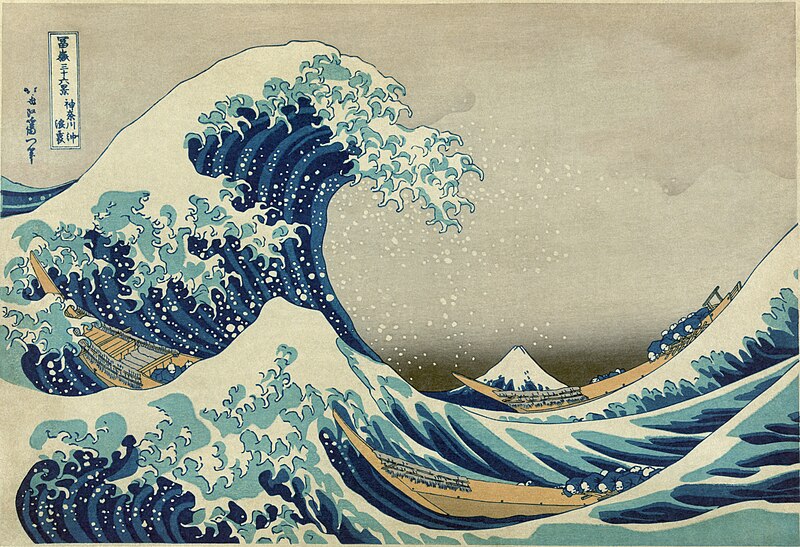
File:Great Wave off Kanagawa2.jpgA few things have come across my Twitter feed in recent weeks that relate to cognition and the Internet. The first is an article by Thomas Erren et al on 10 elements of lifelong learning according to Richard Hamming. I'm a big fan of Hamming's ideas and research philosophy, and the authors do a nice job of updating some important points from his book. I recommend reading the paper; to wet your appetite, the first two rules they describe include
Rule 1. Cultivate Lifelong Learning as a “Style of Thinking” That Concentrates on Fundamental Principles Rather Than on Facts
Rule 2. Structure Your Learning to Ride the Information Tsunami Rather Than Drown in It
These strike a chord when thought about in the context of the recent study by Barr et al, which suggested that smartphones, as entrée to vast stores of information, can supplant critical thinking by making it easy for people to offload thinking to technology. Hamming, Erren et al, and Barr et al collectively remind us of the dangers of merely looking for facts on the Internet as opposed to concentrating on forming a coherent body of knowledge out of those facts.

Eric Topol captures this perfectly in a recent tweet:
The future of medicine is not about looking things up on the Internet; it's being able to generate one's own real world data+super-analytics
I couldn't agree more. Data and "super-analytics" need to be aimed at generating and conveying a coherent picture of health so that consumers of those analytics -- whether researchers, physicians, or non-specialists -- are informed and educated.

As the sea of facts gets larger and more accessible, becoming a tsunami, we face the risk of drowning, as Erren et al suggest, or becoming cognitively lazy, as Barr et al suggest. How do humans synthesize knowledge from data, especially when the data may be messy, variable, or uncertain? In the case of public health, the issue is hugely important, because people will synthesize their own knowledge based on facts they find compelling (e.g., the University of Google, "My science is named Evan"). How do we leverage the information superhighway to produce insight and decisions grounded in the relevant facts?

(image source: Wikipedia)