Showing posts with label immunocompromised individuals. Show all posts

Thursday, July 9, 2015

Measles, vaccines, and the herd

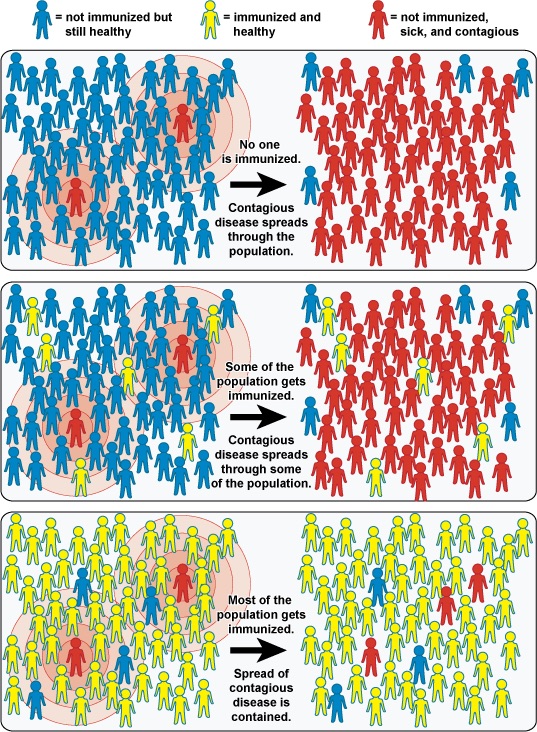
https://upload.wikimedia.org/wikipedia/commons/c/c0/Community_Immunity.jpgThe first confirmed measles death in the US since 2003 was recorded in Washington State recently, where a woman died from measles-associated pneumonia. According to a health department news release, she had an underlying condition and was taking medications that suppressed her immune system. People undergoing immunosuppressive therapy are at high risk of contracting infections and, if they develop infection, often do not exhibit the signs immunocompetent persons show. This woman is thought to have become infected at a medical clinic during a local outbreak; the etiology of her pneumonia wasn't recognized as measles until autopsy.

Measles is highly contagious (R0, the basic reproduction ratio of the pathogen, can be as high as 18) and there are hundreds of thousands, if not millions, of immunocompromised persons in the US who depend upon the immunity of those around them for protection. When a large fraction the community possesses immunity to a pathogen, circulation of the pathogen becomes less intense. When the prevalence of immunity becomes high enough, it ceases to circulate. In this simple picture, if the fraction 11/R0 of a population can be made immune, and that fraction is maintained over time over time, then a pathogen can be eradicated.

In reality, herd immunity is more complex than this. Many complications arise from imperfect vaccine immunity, population heterogeneity (including network effects), uneven vaccination, and those who opt not to receive vaccines. These complexities make it challenging, from a public health practice perspective, to protect populations with vaccines. Nonetheless, this woman's death illustrates how important it is to immunize as many people as possible: Doing so heightens protection of those vulnerable to vaccine preventable infections.

This case has been reported within the context of anti-vaccination notions, or as I prefer to think of it, vaccine skepticism. Regardless of the terminology, there is one simple truth to the incident: She developed what proved to be a fatal infection because someone in her community was not immune to the measles virus. That seems needless when a safe and effective vaccine that conveys long-lived immunity is available. Hopefully laws like those enacted in California and Vermont recently will spread to other states and help to increase the prevalence of vaccine-associated immunity in communities throughout the US.

(image source: Wikipedia)

Sunday, February 1, 2015

Your belief does not trump his right to recover

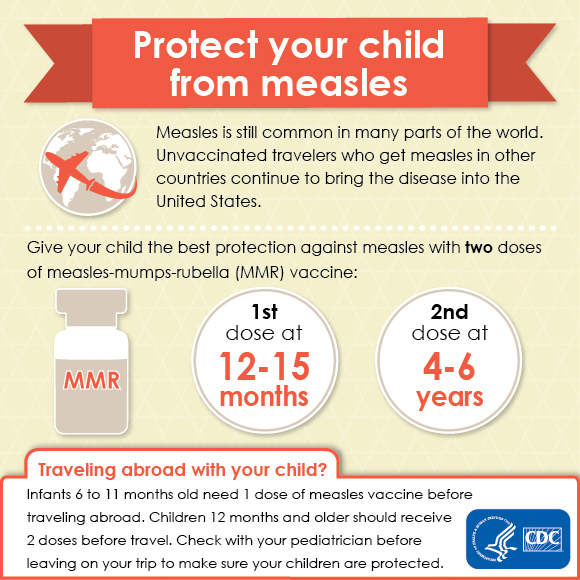
Infographic: Protect your child from measles. Measles is still common in many parts of the world. Unvaccinated travelers who get measles in other countries continue to bring the disease into the United States. Give your child the best protection against measles with two doses of measles-mumps-rubella (MMR) vaccine: 1st dose at 12-15 months, 2nd dose at 4-6 years. Traveling abroad with your child? Infants 6-11 months old need 1 dose of measles vaccine before traveling abroad. Children 12 months and older should receive 2 doses before travel. Check with your pediatrician before leaving on your trip to make sure your children are protected.One story connected to the California measles episode in particular speaks to me. It concerns a dad speaking out, in defense of his son's fragile health, against the decisions of many not to vaccinate their children. The man's son is recovering from leukemia and cannot yet be vaccinated against measles. He is justifiably concerned about unvaccinated classmates posing a potentially mortal infection risk to his son and has requested that such children be barred from school.

The question of why some don't vaccinate their children (or themselves) is complex and multifaceted, but it seems to have one thing in common with other major public health issues of recent times: the idea that "it's my right to". In addition to it's my right to not vaccinate my children, we often hear that it's my right to possess assault rifles and it's my right to have raw milk on the market.

Should these be individual rights? From a public health perspective I would argue no, and point out that there's another fundamental question to be answered: Do we want to live in a society where someone's "rights" endanger the health and wellbeing of others? We've answered that question before for other major public health issues: there are mandatory seat belt laws in many states; it's not legal to drive under the influence of alcohol; and it's not legal to smoke in public areas in many parts of the nation. Such laws attempt to limit the ability of an individual to place others at risk. The dad in California has the right -- in fact, the obligation -- to protect his son's health and wellbeing. Could enacting legislation mandating vaccination except in specific medical circumstances be a solution?

I resonated with the man's concern for his son partially because cancer has touched the lives of close friends of mine. Those at risk from infection due to therapy-related immunocompromise and chronic disease are thought to number in the millions in the US. They have rights and deserve to be protected. Legislation on this issue, if possible, won't happen quickly. Pragmatically, I think we need to understand why some people believe that vaccines are dangerous when there's no evidence to support that claim and much evidence demonstrating that measles -- and other vaccine-preventable preventable diseases -- are lethally dangerous. Why are the likes of Jenny McCarthy more credible to some than the US Institute of Medicine? Understanding such issues may provide a basis for a conversation and, ultimately, change.

(image source: CDC)

Thursday, November 13, 2014

Influenza vaccine recommendations: Stop needling me!

File:14234CDC Flumist.tifSeasonal influenza is responsible for an estimated 200,000 hospitalizations and 23,000 deaths in the US annually. Each year influenza vaccines are produced based on the viruses forecast to become prevalent. There are two types of vaccine: inactivated influenza vaccine (IIV), delivered via injection, and live attenuated influenza vaccine (LAIV), delivered via a mist sprayed into the nose. Influenza vaccines typically have efficacies exceeding 60% and an estimated 46% of the American public relieves vaccine annually.

While many people are vaccinated each year, it is desirable to increase vaccination rates for at least two reasons. First, vaccine-associated immunity protects individuals from developing potentially serious or fatal disease. Second, high population coverage produces a herd immunity effect: those possessing vaccine-associated immunity cannot become infected and thus cannot infect others. This is especially important for protecting individuals for whom vaccines are contraindicated.

Individuals who are immunocompromised or immunosuppressed are such a group. Consider, for example, patients recovering from hematopoietic stem cell transplantation (HSCT) following myeloablative conditioning. In cases of imperfect donor-recipient match, patients may take immunosuppressive medications as prophylaxis against, or treatment for, graft versus host disease. During this process of immunologic tolerization, which can last months or longer, patients must avoid crowds and limit work/school and social interactions in order to avoid potentially fatal infections. And during this period it is critically important for caregivers and contacts to be vaccinated against influenza and other vaccine-preventable diseases so that they do not become infectious.

LAIV is contraindicated for caregivers of such persons in the Advisory Committee on Immunization Practices (ACIP) guidelines. Because LAIV contains live influenza viruses, a potential exists for transmission of vaccine strain viruses from vaccinees to other persons. The period of viral shedding in vaccinees is variable and relatively short lived. Vaccinated immunocompetent children, for example, shed vaccine viruses for less than 3 weeks, and evidence suggests that shedding may be much shorter lived than that. LAIV-associated shedding occurs in lower titers than is typically observed in disease-associated shedding caused by wild-type influenza viruses.

As several studies have demonstrated higher efficacy of LAIV relative to IIV in children (but see the footnote below), the ACIP has expressed
a preference for the use, when immediately available, of live attenuated influenza vaccine (LAIV) for healthy children aged 2 through 8 years, to be implemented as feasible for the 2014–15 season but not later than the 2015–16 season.
Higher protective efficacy of LAIV in children provides strong rationale for the ACIP statement. Moreover, promoting LAIV as an alternative to IIV in older patient populations may result in increased coverage in those who avoid vaccination due to fear of needles. I wonder if increased use of LAIV might pose additional risk to immunocompromised persons, however, in terms of inadvertent exposure to recent vaccinees shedding live, though attenuated, influenza viruses. Such patients may need to become more meticulous in screening visitors and contacts who may have received LAIV recently.

Footnote: During 2013-2014 there was no measurable effectiveness for LAIV against influenza A (H1N1) among children enrolled in effectiveness studies. The reasons for this are unclear.

(image source: Wikipedia)

Saturday, May 10, 2014

Legionella on ice

File:Legionella Plate 01.png"Legionnaires' disease" was the name originally given to an illness observed at a 1976 American Legion convention. Today, we call the illness associated with Legionella pneumophila infection, which can range from mild respiratory illness to severe pneumonia, "legionellosis". Legionella bacteria exist naturally in water and moist soil and colonies tend to grow in warm water, pools of which often form in improperly operated or maintained HVAC systems, hot tubs, and hot water systems. Legionella is an important cause of both hospital- and community-acquired pneumonia in both immunocompetent and immunosuppressed patients. Hospital-acquired cases are often associated with potable water systems colonised with Legionella.

A story in the Pittsburgh Tribune-Review recently described an unusual outbreak at a Pittsburgh hospital. Although the epidemiology showed an association with ice chips, investigators were unable to find Legionella in the hospital water system. How could Legionella appear in ice from machines supplied by cold (not hot) water lines free from the bacterium? It was ultimately determined reservoirs within hospital ice machines were warmed by internal compressors, thus allowing Legionella colonies to grow.

Previous outbreaks involving ice makers and Legionella have been described in the literature (see, e.g., Schuetz et al, 2009, Graman et al, 1997, and Stout et al, 1985), but I doubt that many would immediately respond "ice machine" when asked about likely sources of Legionella infection in a hospital. Though anecdotal, this story illustrates how counter-intuitive outbreak investigation can be: One wouldn't necessarily think to look in a freezer for a bug that needs warm water to grow. But there it was, and hospital investigators figured it out when the ice chips were implicated. Bravo! 

(image source: Wikipedia)

Monday, March 17, 2014

Bacterial interference and the deliberate colonization of patients

File:Staphylococcus aureus VISA 2.jpgBeginning in the mid-1940s and lasting until the late 1960s, the world saw a dramatic pandemic of staphylococcal infections. This post describes a curious historical episode in research aimed at controlling Staph outbreaks toward the end of that period.

One of the fundamental ideas in ecology is that, depending on the environment and properties of individuals, some types of individuals can out compete other types. When this happens, the less successful individuals can become incompletely or completely displaced. In the 1960s, the idea of microbial competition was actively applied to clinical medicine in a fascinating series of studies, which ultimately ended in tragedy. These studies investigated an idea known as "bacterial interference": the inability of a strain of a bacterium, in this case Staphylococcus aureus, to colonize a particular site of a host following deliberate colonization of that site with another strain of the bacterium.

The notion of using bacterial interference for controlling or preventing epidemics of Staph in hospital nurseries was evaluated and several trials were carried out. How this idea came about and how the studies were done is fascinating and is described in Boris, 1968 and references therein. As the nose is one of the main ecological niches of Staph aureus in humans, newborns were deliberately colonized with an apparently apathogenic strain of Staph aureus (called "strain 502A", after the phage typing scheme then in use) by swabbing the nose and the umbilical stump shortly after birth.

The results were dramatic. Clinical and epidemiological observation revealed a striking lack of staphylococcal disease in the infant study population and in their families. As Shinefield et al 1966 summarized the situation:
It has been clearly demonstrated that artificial colonization of the nasal mucosa of newborns with one strain of Staphylococcus aureus interferes with subsequent acquisition of a second strain of S aureus. This deliberate colonization of infants shortly after birth with a staphylococcal strain of low virulence (strain 502A) has been employed to protect infants from colonization and disease with virulent epidemic strains of S aureus.
The studies on children in university hospital environments were extended to children in a community hospital setting in Light et al, 1967, and found to be effective. Boris et al 1964 applied the idea to adults.

There were reservations discussed in the literature, however. An echo of that concern can be seen in an August 3, 1968, issue of the British Medical Journal, in a short report on a NEJM paper by Light et al describing observations of bacterial interference (not involving deliberate colonization) between Staph aureus and Pseudomonas. In the report, an anonymous author referred to the trials evaluating deliberate colonizations, mentioning that
Ethical objections have been raised to this procedure, but it seems no more objectionable from this standpoint than the use of living vaccines.
Unfortunately, adverse effects soon became known, including a death from infection with the 502A strain. Writing in 1972, Houck et al reported on complications associated with bacterial interference trials. A passage from the abstract describes the death due to septicemia,
An infant of a diabetic mother developed septicemia and meningitis, probably secondary to passing an umbilical vein catheter through the colonized umbilical stump. Staphylococcus aureus 502A and Escherichia coli were isolated from blood culture before death and from autopsy cultures of blood and peritoneum. A meningeal culture grew S aureus 502A. Gram-positive cocci were identified in liver, lung, heart, and meninges. 
They also noted that 
Only two (0.5%) minor 502A infections were seen in 444 spontaneously colonized infants. The benefits of S aureus 502A programs far outweigh their hazards. Disease due to the 502A strain is more frequent when the inoculum applied to the infant is large than when it is kept below 4,000 bacteria. The fatal case emphasizes that bacteria of extremely low virulence may produce serious disease in compromised hosts and that catheterization through a contaminated umbilical stump may induce bacteremia.
Although I haven't done an extensive search for bacterial interference programs after the publication of Houck et al 1972, these activities seem to have terminated after the death.

There are so many things to ponder regarding this curious episode in the 1960s, including how the one death in a few hundred patients, interpreted by Houck et al as a risk far outweighing the hazards, contrasts with current thresholds for attributable risk. Another is the remark that pathogens "of extremely low virulence may produce serious disease in compromised hosts", and how that notion is similar to the practice of avoiding live virus vaccines in recovering HSCT patients during immune system reconstitution.

Recently, Mukherjee and coworkers observed that the beneficial fungal yeast Pichia inhibits growth of pathogenic fungi, including Candida. Candida causes oral candidiasis (thrush) in immunocompromised and immunosuppressed patients. This is exciting; one of the study authors commented
One day, not only could this lead to topical treatment for thrush, but it could also lead to a formulation of therapeutics for systemic fungal infections in all immunocompromised patients . . . In addition to patients with HIV, this would also include very young patients and patients with cancer or diabetes.
I think it's important to know about the history of bacterial interference interventions so that past issues can be recognized and actively avoided in related future investigations.

(image source: Wikipedia