Showing posts with label legislation. Show all posts

Thursday, July 9, 2015

Measles, vaccines, and the herd

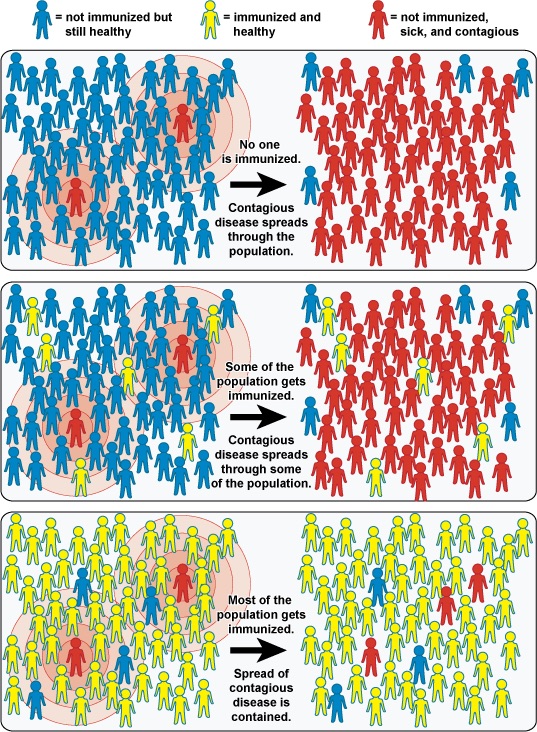
https://upload.wikimedia.org/wikipedia/commons/c/c0/Community_Immunity.jpgThe first confirmed measles death in the US since 2003 was recorded in Washington State recently, where a woman died from measles-associated pneumonia. According to a health department news release, she had an underlying condition and was taking medications that suppressed her immune system. People undergoing immunosuppressive therapy are at high risk of contracting infections and, if they develop infection, often do not exhibit the signs immunocompetent persons show. This woman is thought to have become infected at a medical clinic during a local outbreak; the etiology of her pneumonia wasn't recognized as measles until autopsy.

Measles is highly contagious (R0, the basic reproduction ratio of the pathogen, can be as high as 18) and there are hundreds of thousands, if not millions, of immunocompromised persons in the US who depend upon the immunity of those around them for protection. When a large fraction the community possesses immunity to a pathogen, circulation of the pathogen becomes less intense. When the prevalence of immunity becomes high enough, it ceases to circulate. In this simple picture, if the fraction 11/R0 of a population can be made immune, and that fraction is maintained over time over time, then a pathogen can be eradicated.

In reality, herd immunity is more complex than this. Many complications arise from imperfect vaccine immunity, population heterogeneity (including network effects), uneven vaccination, and those who opt not to receive vaccines. These complexities make it challenging, from a public health practice perspective, to protect populations with vaccines. Nonetheless, this woman's death illustrates how important it is to immunize as many people as possible: Doing so heightens protection of those vulnerable to vaccine preventable infections.

This case has been reported within the context of anti-vaccination notions, or as I prefer to think of it, vaccine skepticism. Regardless of the terminology, there is one simple truth to the incident: She developed what proved to be a fatal infection because someone in her community was not immune to the measles virus. That seems needless when a safe and effective vaccine that conveys long-lived immunity is available. Hopefully laws like those enacted in California and Vermont recently will spread to other states and help to increase the prevalence of vaccine-associated immunity in communities throughout the US.

(image source: Wikipedia)

Sunday, February 1, 2015

Your belief does not trump his right to recover

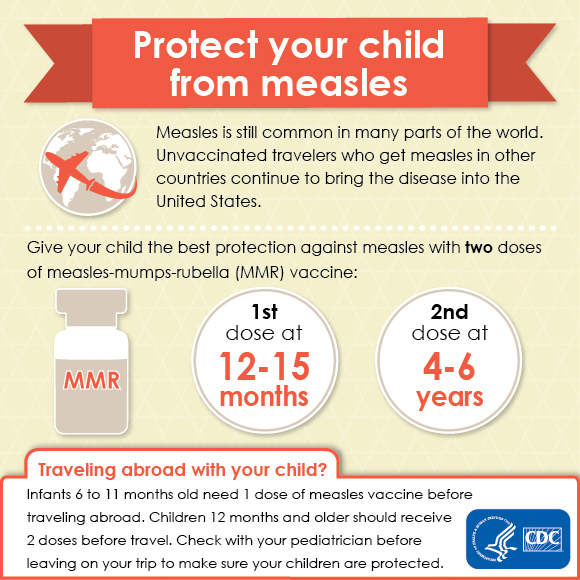
Infographic: Protect your child from measles. Measles is still common in many parts of the world. Unvaccinated travelers who get measles in other countries continue to bring the disease into the United States. Give your child the best protection against measles with two doses of measles-mumps-rubella (MMR) vaccine: 1st dose at 12-15 months, 2nd dose at 4-6 years. Traveling abroad with your child? Infants 6-11 months old need 1 dose of measles vaccine before traveling abroad. Children 12 months and older should receive 2 doses before travel. Check with your pediatrician before leaving on your trip to make sure your children are protected.One story connected to the California measles episode in particular speaks to me. It concerns a dad speaking out, in defense of his son's fragile health, against the decisions of many not to vaccinate their children. The man's son is recovering from leukemia and cannot yet be vaccinated against measles. He is justifiably concerned about unvaccinated classmates posing a potentially mortal infection risk to his son and has requested that such children be barred from school.

The question of why some don't vaccinate their children (or themselves) is complex and multifaceted, but it seems to have one thing in common with other major public health issues of recent times: the idea that "it's my right to". In addition to it's my right to not vaccinate my children, we often hear that it's my right to possess assault rifles and it's my right to have raw milk on the market.

Should these be individual rights? From a public health perspective I would argue no, and point out that there's another fundamental question to be answered: Do we want to live in a society where someone's "rights" endanger the health and wellbeing of others? We've answered that question before for other major public health issues: there are mandatory seat belt laws in many states; it's not legal to drive under the influence of alcohol; and it's not legal to smoke in public areas in many parts of the nation. Such laws attempt to limit the ability of an individual to place others at risk. The dad in California has the right -- in fact, the obligation -- to protect his son's health and wellbeing. Could enacting legislation mandating vaccination except in specific medical circumstances be a solution?

I resonated with the man's concern for his son partially because cancer has touched the lives of close friends of mine. Those at risk from infection due to therapy-related immunocompromise and chronic disease are thought to number in the millions in the US. They have rights and deserve to be protected. Legislation on this issue, if possible, won't happen quickly. Pragmatically, I think we need to understand why some people believe that vaccines are dangerous when there's no evidence to support that claim and much evidence demonstrating that measles -- and other vaccine-preventable preventable diseases -- are lethally dangerous. Why are the likes of Jenny McCarthy more credible to some than the US Institute of Medicine? Understanding such issues may provide a basis for a conversation and, ultimately, change.

(image source: CDC)

Monday, December 29, 2014

Closing the loop on raw milk legislation

Earlier this year I blogged several times about raw milk and the movement advocating drinking it. One of those posts mentioned the Milk Freedom Act of 2014, a bill introduced by Rep. Thomas Massie of Kentucky, which, if passed, would have
Prohibit[ed] a federal department, agency, or court from taking any action that would prohibit, regulate, or otherwise restrict the interstate traffic of milk or a milk product that is unpasteurized and packaged for direct human consumption if such action is based solely upon a determination that because the milk or milk product is unpasteurized it is adulterated, misbranded, or otherwise in violation of federal law.
Just to circle back and check up on the status of the bill, it seems to have gone nowhere. The only echoes that came up in a quick Google search were comments attributed to Massie at a meeting called the "Food Freedom Fest" in September. The comments appear on a food rights and raw milk blog by David Gumpert:
U.S. Congressman Thomas Massie . . . was pessimistic about the chances of actually passing anything in the House of Representatives. Indeed, it isn’t even likely the legislation will get a hearing. “The dairy industry went apoplectic when we introduced the legislation,” he said. “My wife said she didn’t know the lactose industry was so intolerant.” . . . Massie told me after his talk that the best chance to get raw milk legislation through Congress and into law would be as part of some other appropriations bill guaranteed passage. Even that route is a long shot, he said, since not many appropriations bills are likely to get through in the coming year or so.
An alternate interpretation of these comments could be that a bill at odds with the basic tenants of food safety and that would place public health at risk if passed was opposed by corporations who have invested immensely in an infrastructure to deliver safe food. The only way that the bill might get passed is if it piggy backs onto a large appropriations bill, but that probably won't happen because the Congress isn't doing much these days anyway.

So, we can all rest well knowing that the Milk Freedom Act of 2014 will never see the light of day. Thank goodness for a Congress that perfected the art of doing little.

(image source: David Hartley)

Tuesday, April 8, 2014

Raw milk, part III: The battle on the Hill

File:United States Capitol dome daylight.jpgI've written previously about the raw milk movement and the dangers of consuming raw milk. Now two bills have been introduced in Congress by Rep. Thomas Massie (Republican, Kentucky). According to the Congressional Research Service, the “Milk Freedom Act of 2014
Prohibits a federal department, agency, or court from taking any action that would prohibit, regulate, or otherwise restrict the interstate traffic of milk or a milk product that is unpasteurized and packaged for direct human consumption if such action is based solely upon a determination that because the milk or milk product is unpasteurized it is adulterated, misbranded, or otherwise in violation of federal law.
The second bill, the “Interstate Milk Freedom Act of 2014
Prohibits a federal department, agency, or court from taking any action that would prohibit, regulate, or otherwise restrict the interstate traffic of milk or a milk product that is unpasteurized and packaged for direct human consumption if: (1) such action is based solely upon a determination that because the milk or milk product is unpasteurized it is adulterated, misbranded, or otherwise in violation of federal law; (2) the milk or milk product's state of origin allows unpasteurized milk or unpasteurized milk products to be distributed for direct human consumption by any means; (3) the milk or milk product is produced, packaged, and moved in compliance with the laws of such state of origin; and (4) the milk or milk product is moved from the state of origin for transport to another state which allows the distribution of unpasteurized milk or unpasteurized milk products for direct human consumption.
The rationale for the two bills? Personal liberty. Politico quotes Rep. Massie as saying
Today, many people are paying more attention to the food they eat, what it contains, and how it is processed. Raw milk, which has been with us for thousands of years, is making a comeback among these discerning consumers. Personal choices as basic as ‘what we feed our families’ should not be limited by the federal government. [Emphasis added.]
It's an argument that has been heard before.

It's important to understand how individuals advocating such positions evaluate the choice between the "right" to endanger themselves and those around them (e.g., children and others to whom they serve raw milk) versus the right to personal and public safety. Certainly this choice exists in other areas of human behavior and legislative decisions have been made to protect public and individual health. For example, drinking and driving is not legal. Nor is driving without a seatbelt in many states. Smoking in public places is strongly curtailed for public health and other reasons. One doesn't have the right to manufacture or possess substances like ricin that are dangerous to self and others.

Why are some more passionate about having access to potentially harmful and deadly raw milk than avoiding infections that can come from it? If you feed raw milk to a child or other individual who doesn't have the capacity or capability to evaluate the risk, isn't that unethical? I've yet to meet anyone who really embraces the prospect of E. coli associated dysentery followed by HUS and renal failure. We must do better as educators and communicate the dangers more effectively, and we must do better at listening so that we can truly understand what raw milk advocates are threatened by.

(image source: Wikimedia Commons)