Showing posts with label C diff. Show all posts

Saturday, May 9, 2015

Microbial ecology: Keeping one step ahead of the bad bugs

File:Clostridium difficile 01.pngTwo papers were published recently that apply notions of bacterial interference and competition rather elegantly. The first was a study by Dale Gerding et al on administering nontoxigenic Clostridium difficile spores to prevent recurrent C. diff infection. The study aimed to determine the safety, fecal colonization, recurrence rate, and optimal dosing schedule of nontoxigenic C. difficile, and the authors found that
Among patients with CDI who clinically recovered following treatment with metronidazole or vancomycin, oral administration of spores of NTCD-M3 was well tolerated and appeared to be safe. Nontoxigenic C. difficile strain M3 colonized the gastrointestinal tract and significantly reduced CDI recurrence. 
It's a fascinating study and I recommend reading it. In addition to contemplating this as a potential future treatment for recurrent CDI, it's intriguing to wonder if patients could have their GI tracts colonized by nontoxigenic C. diff prophylactically before receiving antibiotics associated with CDI.

The other study, by Alice Deasy et al, demonstrates how nasal inoculation with the commensal Neisseria lactamica inhibits carriage of N. meningitidis in young adults. N. lactamica is a commensal occupying the same ecological niche (the nasopharynx) as the pathogenic organism N. meningitidis, which is associated with epidemic meningitis. They observed a significant inhibition of meningococcal carriage in carriers of N. lactamica, which was attributed to displacement of existing meningococci and to inhibition of new acquisition. Their findings suggest N. lactamica as a potential "novel bacterial medicine to suppress meningococcal outbreaks". Again, I recommend reading the complete study.

The notion of exploiting microbial ecology is appealing for many reasons, including that it doesn't require developing intrinsically new pharmacologic compounds and that it may have no significant side effects. At the same time, its important to remember previous trials employing bacterial interference, such as the deliberate colonization of newborn children with "low virulence" Staph. aureus, so that old missteps aren't repeated.

(image source: Wikipedia)

Friday, August 29, 2014

Nowhere is it written that dangerous pathogens must have high basic reproduction ratios

As discussed previously, there are lessons aplenty to learn from the ongoing Ebola outbreak in West Africa. One simple lesson is this: Even with a low basic reproduction ratio (symbolized mathematically as R0), a pathogen can still spread widely under the right conditions.

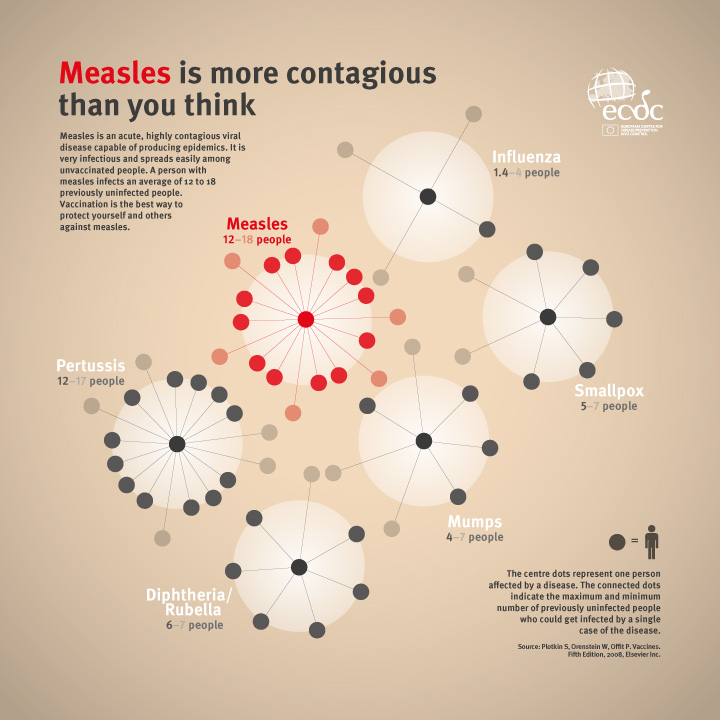
Current estimates of the basic reproduction number for this Ebola outbreak are roughly in the range of 1.3-2.5. That's pretty modest when compared with other notorious agents. Estimates of R0 for smallpox outbreaks, for example, were typically 4-10 and those for cholera epidemics can be in the range of 3-12. Measles outbreaks can have R0 values of up to 18.

R0 itself is sometimes thought of as a surrogate for "epidemic potential". Certainly, and by definition, pathogens with high R0 spread quickly, whereas pathogens with lower R0 don't. Does this mean that pathogens possessing relatively low values of R0 have lower potential to harm public health?

Certainly not. In fact, pandemic influenza viruses, for example, often fall in the range 1.5-2.0. Pathogens associated with lower values of R0 can spread widely if control efforts are not effective. In the case of pandemic influenza, control measures include vaccination and handwashing. In the current Ebola situation, due to a range of social, economic, and political factors, it has been difficult to implement widespread, effective control measures. The infection has thus spread and will likely continue do so in the region.

Does this have implications for other infections? It absolutely does. One could imagine some theoretical pathogen, for example, that is spread predominantly by hands (call it "pathogen X") and that is not killed by alcohol based hand rub (ABHR). Then, in circumstances where ABHRs are used in place of handwashing, one might imagine that pathogen X could, over time, become widely prevalent, even if it does not possess a high R0. Pathogen X might be similar to Clostridium difficile; one estimate of R0 for C. difficile is in the range 0.5-1.5.

For this reason, we should not think only in terms of R0 for classifying pathogens as dangerous or not. While high R0 pathogens spread quickly, leaving little time to react and take action, Ebola in West Africa this year demonstrates that a pathogen possessing a more modest R0 can result in a dangerous public health situation. 

There's a story, which is possibly apocryphal, that Enrico Fermi once remarked that nowhere is it written that the laws of physics must be linear. I think there's an analogue that should be kept in mind in infectious disease epidemiology: Nowhere is it written that dangerous pathogens must have high R0.

(image source: ECDC) 

Tuesday, April 29, 2014

Vaccines: A tool for the post-antibiotic era?

PHIL Image 14537In honor of World Immunization Week this week, I recently read two books by Paul Offit: Vaccinated: One Man's Quest to Defeat the World's Deadliest Diseases and The Cutter Incident: How America’s First Polio Vaccine Led to the Growing Vaccine Crisis. Both are excellent. Vaccinated is essentially a biography of Maurice Hilleman, but it also reviews how several of the important vaccines currently in use were developed and marketed. The Cutter Incident tells the story of incompletely inactivated lots of polio vaccine manufactured by Cutter Laboratories, which caused 40,000 cases of polio nationwide in 1955, including 200 cases of paralysis and 10 deaths. There are many pearls and much wisdom to be found in the pages of these two books; I recommend reading them.

Certainly the utility of vaccines is well demonstrated and their development and application is one of the major accomplishments of modern medicine. In the US alone the improvement of population health as vaccines have become available is remarkable. Globally, it has been estimated that vaccines prevent nearly 6 million deaths annually worldwide.

The books got me thinking about future potential vaccines. In one passage, Offit recounts the development of a pneumococcal vaccine and quotes Robert Austrian talking about the rationale for his work:
The only alternative then to protect those at high risk of early death is to prevent them from becoming ill.
This beautiful and simple idea -- a medical and public health truism if ever there was one ("an ounce of prevention is worth a pound of cure") -- strikes me as relevant to HAI and antibiotic resistant infections. Think what healthcare might be like if there were vaccines for many of the bacterial infections that are currently problematic and often resistant to antibiotics, like Staphylococcus aureus, Clostridium difficile, and Neisseria gonorrhoeae.

Several antibacterial vaccines are available, including ones for pertussis, tetanus, diphtheria, meningococcus, pneumococcus, Haemophilus influenzae type b (Hib) disease, cholera, typhoid, and anthrax. However, there are reasons that vaccines for S. aureus, C. diff, and N. gonorrhoeae (as well as others) don't yet exist. For one, the immunology can be complex, as Offit explains in the discussion of the pneumococcal vaccine. Proctor describes the situation for Staph aureus in a recent review, as do Fowler and Proctor in another review. Also, the cost of developing, testing, and licensing can be steep relative to the profits of a licensed, marketed vaccine. Yet another issue is the specter of adverse events, both real and perceived. On this point, Offit notes that
. . . a technology that would clearly save lives sits on the shelf. "We could make a group B strep vaccine tomorrow," said one senior pharmaceutical company scientist. "But it would have to be given to pregnant women and we couldn't handle the liability." 
Dempsey et al offers a recent, interesting, and partially validating study to this view of a potential group B strep (GBS) vaccine. Such issues are difficult.

That being said, perhaps vaccines should be emphasized more in the conversation regarding antibiotic resistance. I've wondered in the past about the effectiveness of developing new antibiotics when there seems to be little reason to believe, given the past track record, that they will be used responsibly. A new generation of antibiotic drugs could become useless within a few years if effective antibiotic stewardship isn't practiced globally. Vaccines, if they could be made, may offer protection against what may soon be untreatable infections. Or put differently, perhaps vaccines could be an important tool in a post-antibiotic era.

Of course, there are issues to be better understood and addressed. Recent work illustrates that Bordetella pertussis is evolving in response to the vaccine, raising the possibility that future vaccines may be associated with similar dynamics. Also, vaccines to human commensals like Staphylococcus aureus might promote overgrowth of other commensal organisms. Studies have investigated this for the case of Streptococcus vaccination and MRSA colonization and infection. Moreover, it's unclear whether people would really embrace more vaccinations given the current and recent climate surrounding vaccines.

Regardless, one seldom hears about vaccines in the conversation about antibiotic resistance. It seems like funding should address making new vaccines as well as development of new antibiotic drugs -- because Robert Austrian was right. 

(image source: CDC/PHIL)

Wednesday, April 2, 2014

Hand washing, rubbing, and posters

Every now and then one sees something that is obviously well intentioned and potentially even effective, but that is problematic nonetheless. A case in point is the poster shown at the right, proclaiming that "Alcohol-based handrubs kill bacteria more effectively than soap and water." Certainly they do, but that's not the point of handwashing with plain soap and water.

The purpose of handwashing with plain soap is to mechanically remove foreign material and microorganisms from the surface of the skin. It is not to kill microbes. Plain soaps have minimal, if any, antimicrobial activity. The purpose of alcohol-based handrubs (ABHRs) is to reduce the microbial burden on the skin to a safe level through the antimicrobial action of alcohol. Because handrubs do not remove organic material, they are not a substitute for washing visibly soiled hands. Moreover, ABHRs don't kill spore forming microorganisms such as Clostridium difficile or certain other pathogens of public health importance. Handwashing with soap and water is needed to remove such contamination. Antimicrobial soap combines the cleaning action of regular soap with antiseptic activity. 

These and related issues, such as when the different approaches are best used, are well covered by Manfred Rotter in chapter 91 of the 4th edition (2012) of the expansive text Hospital Epidemiology and Infection Control. Additional information can be found in the WHO guidelines on hand hygiene in healthcare and at a related CDC website. 

In the case of the poster above, it is available at a URL that is part of an interactive education module on hand hygiene for professional HCWs. The training itself, consistent with the poster, advises (on slide #19) that plain soaps are "good" at killing bacteria whereas ABHRs are "best" and antimicrobial soaps fall in between. I can't find evidence that plain soap kills bacteria or any other pathogen. Rather, plain soap removes pathogens by acting as a surfactant or detergent, and this seems to be well established in the literature. Perhaps "Remember to wash your hands -- Soap removes germs!" or "Alcohol-based hand rubs are often an effective alternative to soap for making your hands safe!" would have been more evidence-based, defensible, and constructive messages for a poster.

More importantly, if the overarching objective of hand hygiene -- preventing transmission of microorganisms via the hands -- is to be achieved, an awareness of the issues involved in the various approaches is needed. Knowing when to wash versus rub, and why, seems relevant to communicate widely.

(image source: CDC)