Showing posts with label anti-vaccination. Show all posts

Friday, November 20, 2020

COVID-19: What went wrong?

Another week has passed, and the infection curve in the United States continues to increase. How we can even be in this situation is baffling, given the massive investment and research on emerging infectious diseases and other biological threats that preceded this pandemic. Equally baffling is the narrative -- founded in misinformation, disinformation, and agenda -- perpetrated on the American people. The charade is exemplified over and over. Today's act unfolded in a Senate hearing on hydroxychloroquine, a drug demonstrated to be contraindicated for COVID treatment. And yet, the exponential increase continues. 


States are showing the strain. In Ohio, for example, the state's disease reporting and information system has buckled. Citizens cannot now be confident, at least at the moment, in the data published on disease incidence.

The Pandemic and All-Hazards Preparedness Act (2006) was to, among other things, “Establish a near real-time electronic nationwide public health situational awareness capability through an interoperable network of systems to share data and information to enhance early detection of, rapid response to, and management of, potentially catastrophic infectious disease outbreaks and other public health emergencies that originate domestically or abroad.” Little if any progress has been made toward that goal. Too many health departments still receive information by fax and enter data by hand. This is madness.

We're beginning to learn about vaccine candidates that hold promise. Additional candidate vaccines will undoubtedly emerge, and hopefully in 2021 one or more approved vaccines will become widely available. Hopefully people will receive them. When the pandemic finally does abate -- which is not likely for months -- we must objectively and without delusion identify what broke in our public health and related systems and fix them.

Thursday, July 9, 2015

Measles, vaccines, and the herd

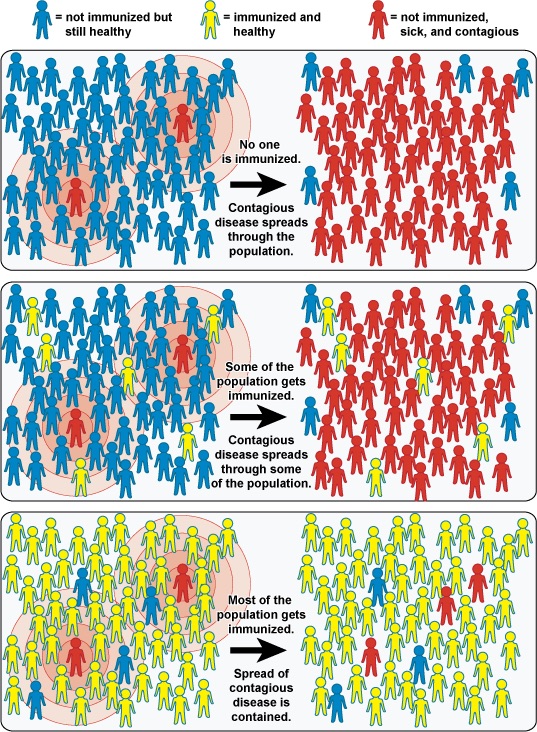
https://upload.wikimedia.org/wikipedia/commons/c/c0/Community_Immunity.jpgThe first confirmed measles death in the US since 2003 was recorded in Washington State recently, where a woman died from measles-associated pneumonia. According to a health department news release, she had an underlying condition and was taking medications that suppressed her immune system. People undergoing immunosuppressive therapy are at high risk of contracting infections and, if they develop infection, often do not exhibit the signs immunocompetent persons show. This woman is thought to have become infected at a medical clinic during a local outbreak; the etiology of her pneumonia wasn't recognized as measles until autopsy.

Measles is highly contagious (R0, the basic reproduction ratio of the pathogen, can be as high as 18) and there are hundreds of thousands, if not millions, of immunocompromised persons in the US who depend upon the immunity of those around them for protection. When a large fraction the community possesses immunity to a pathogen, circulation of the pathogen becomes less intense. When the prevalence of immunity becomes high enough, it ceases to circulate. In this simple picture, if the fraction 11/R0 of a population can be made immune, and that fraction is maintained over time over time, then a pathogen can be eradicated.

In reality, herd immunity is more complex than this. Many complications arise from imperfect vaccine immunity, population heterogeneity (including network effects), uneven vaccination, and those who opt not to receive vaccines. These complexities make it challenging, from a public health practice perspective, to protect populations with vaccines. Nonetheless, this woman's death illustrates how important it is to immunize as many people as possible: Doing so heightens protection of those vulnerable to vaccine preventable infections.

This case has been reported within the context of anti-vaccination notions, or as I prefer to think of it, vaccine skepticism. Regardless of the terminology, there is one simple truth to the incident: She developed what proved to be a fatal infection because someone in her community was not immune to the measles virus. That seems needless when a safe and effective vaccine that conveys long-lived immunity is available. Hopefully laws like those enacted in California and Vermont recently will spread to other states and help to increase the prevalence of vaccine-associated immunity in communities throughout the US.

(image source: Wikipedia)

Tuesday, February 24, 2015

Vaccines: What do we think?

2015 measles cases in the U.S., January 1 to February 20, 2015. Map of the U.S. indicates in shades of light to dark blue the number of cases. Twelve states (Colorado, Delaware, Georgia, Michigan, Minnesota, Nebraska, New Jersey, New York, Pennsylvania, South Dakota, Texas, and Utah) and the District of Columbia have 1 to 4 cases. Three states (Arizona, Nevada and Washington) have 5 to 9 cases. One state (Illinois) has 10 to 19 cases and one state (California) has 20 or more cases. These are provisional data reported to CDC’s National Center for Immunization and Respiratory Diseases.CNN published a poll on Monday of this week that contains some interesting statistics. A story announcing the poll began
A new CNN/ORC poll shows nearly 8 of 10 Americans believe parents should be required to vaccinate their healthy children against preventable diseases such as measles, mumps, rubella and polio. If the children are not vaccinated, most agree the child should not be allowed to attend public school or day care . . . 
The basic methodology and results are described here. Overall, 78% of respondents believed parents should be required to vaccinate children against preventable diseases if they are healthy. The age stratified results depict an interesting trend: Older Americans are most supportive of required vaccinations (84% of those 50+ versus 72% of those under 50) and those at the younger end of the spectrum -- and in particular, those of common childbearing ages -- are much less supportive (only 67% of those 18-34 years of age).

Pondering these statistics might lead one to muse that it would have been useful if the poll, rather than asking if parents should be required to vaccinate, had instead asked simply if parents should vaccinate. On Tuesday another poll appeared, this time by Reuters/Ipsos, that asked just that. Information on that poll can be found here. A Reuters news story summarized this poll:
Seventy-eight percent of respondents in the online survey said all children should be vaccinated unless there is a direct health risk to them from vaccination. Only 13 percent opposed vaccinations. . . 
The story went on to note that the "numbers are absolutely overwhelming in favor of vaccinations with a consistent minority in opposition." That's good, but probably not good enough. Herd immunity likely needs to be over 90% in order to eliminate measles. If the poll was representative of the larger US population, then the 78% statistic suggests that we have some work to do.

Of course, polls are not compete studies, and it's hard to know what to make of such results. However, I don't think they're entirely reassuring.

(image source: CDC)

Sunday, February 1, 2015

Your belief does not trump his right to recover

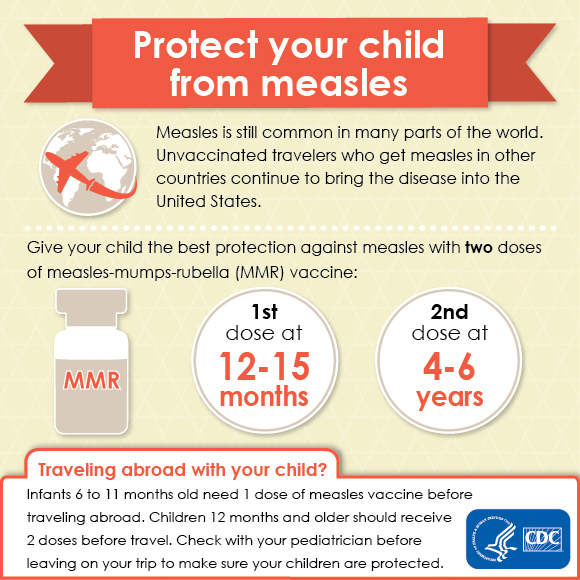
Infographic: Protect your child from measles. Measles is still common in many parts of the world. Unvaccinated travelers who get measles in other countries continue to bring the disease into the United States. Give your child the best protection against measles with two doses of measles-mumps-rubella (MMR) vaccine: 1st dose at 12-15 months, 2nd dose at 4-6 years. Traveling abroad with your child? Infants 6-11 months old need 1 dose of measles vaccine before traveling abroad. Children 12 months and older should receive 2 doses before travel. Check with your pediatrician before leaving on your trip to make sure your children are protected.One story connected to the California measles episode in particular speaks to me. It concerns a dad speaking out, in defense of his son's fragile health, against the decisions of many not to vaccinate their children. The man's son is recovering from leukemia and cannot yet be vaccinated against measles. He is justifiably concerned about unvaccinated classmates posing a potentially mortal infection risk to his son and has requested that such children be barred from school.

The question of why some don't vaccinate their children (or themselves) is complex and multifaceted, but it seems to have one thing in common with other major public health issues of recent times: the idea that "it's my right to". In addition to it's my right to not vaccinate my children, we often hear that it's my right to possess assault rifles and it's my right to have raw milk on the market.

Should these be individual rights? From a public health perspective I would argue no, and point out that there's another fundamental question to be answered: Do we want to live in a society where someone's "rights" endanger the health and wellbeing of others? We've answered that question before for other major public health issues: there are mandatory seat belt laws in many states; it's not legal to drive under the influence of alcohol; and it's not legal to smoke in public areas in many parts of the nation. Such laws attempt to limit the ability of an individual to place others at risk. The dad in California has the right -- in fact, the obligation -- to protect his son's health and wellbeing. Could enacting legislation mandating vaccination except in specific medical circumstances be a solution?

I resonated with the man's concern for his son partially because cancer has touched the lives of close friends of mine. Those at risk from infection due to therapy-related immunocompromise and chronic disease are thought to number in the millions in the US. They have rights and deserve to be protected. Legislation on this issue, if possible, won't happen quickly. Pragmatically, I think we need to understand why some people believe that vaccines are dangerous when there's no evidence to support that claim and much evidence demonstrating that measles -- and other vaccine-preventable preventable diseases -- are lethally dangerous. Why are the likes of Jenny McCarthy more credible to some than the US Institute of Medicine? Understanding such issues may provide a basis for a conversation and, ultimately, change.

(image source: CDC)

Sunday, January 25, 2015

When it comes to measles, it is a small world after all

Dan Diamond wrote an essay recently in Forbes in which he notes the asymmetry of public reaction to Ebola versus measles. He describes how on the one hand, even though Ebola was unlikely to cause an epidemic in the US the public went nuts with Fearbola, while on the other hand measles represents a much more realistic threat of spread but people are somewhat apathetic about it. It seems a valid observation.

It may be difficult to understand public perception of threat when it comes to infectious disease, but, epidemiologically speaking, there are some important differences between the two, as partially summarized in the table below.


Measles Ebola
R0 ~7-18 ~2
Serial interval 8-12 days 5-15 days
Incubation period 10-12 days 2-12 days
CFR 3% 25-90%
Infectious period ~ 4 days before rash to several days after onset of rash At onset of symptoms
Vaccine preventable Yes No

Importantly, persons infected with measles virus are infectious before they begin to feel ill, so they are able to spread the virus in the course of their normal activities. Fearbola -- the epidemic of hyped and often unfounded messages surrounding the threat of Ebola to the US -- struck in part because of the high case fatality rate (CFR) and the lack of a vaccine conveying immunity to the Ebola virus. That contrasts strongly with measles. Even though the measles outbreak that started at Disneyland Resort Theme Parks in California is expanding, I doubt there will be a Fearmeasles epidemic, even though measles can be fatal and cause long term sequelae.

That said, this is a fascinating event due partially to people's attitudes regarding vaccines. Recently, the ramifications of such attitudes, in terms of implications for public health agencies, has been expressed very clearly by Lisa Aliferis (writing for NPR):
Local health officers in counties [in California] affected are busy tracing those who infected patients have been in contact with. Dr. Erica Pan, deputy health officer of Alameda County, says the county has shifted resources from Ebola preparedness to contact tracing for measles. Last year there were four cases of measles in Alameda County, she said, "but we had 400 contacts to investigate."
This is remarkable. On 23 January, the California Department of Health reported that in LA and Orange counties alone there were 31 confirmed cases. A simple back-of-the-envelope calculation suggests that if 4 cases required 400 contacts to be investigated (100 contacts per case on average), then 31 cases could require 3100 contacts to be investigated. No wonder health departments are refocusing resources away from Ebola and onto measles.

People who do not vaccinate their children, or catch up on missed vaccines as adults, do not only place themselves in danger of infection, they place the community in danger. Moreover, they cause scarce public health resources to be spent on controlling a vaccine preventable disease. It's ironic that the lyrics to It's a small world -- the theme song of a ride at Disneyland of the same name -- read
It's a world of laughter, a world of tears.
It's a world of hopes and a world of fears.
There's so much that we share,
That it's time we're aware
It's a small world after all. 
Indeed.

(image source: Wikipedia)

Friday, January 23, 2015

Recall bias, or how I learned to stop worrying about measles and love my vaccination beliefs

The multi-state outbreak of measles in the US, which originated at Disneyland theme parks in California, has received much attention in the press recently. Sadly, the event isn't terribly surprising: many people, including children, lack immunity. The reasons for this are varied, and include the MMR vaccine being recommended for children over 12 months of age; persons not completing the recommended vaccination sequence; waning immunity in older persons; and lack of vaccination.

This latter issue is related to the anti-vaccination movement and this dimension is receiving attention in the media. Some of the discourse is revealing. One example appeared in the New York Times recently, which quoted a Santa Monica pediatrician who has cautioned against the way vaccines are used in the past (but does administer the vaccine in his practice):
“I think whatever risk there is -- and I can’t prove a risk -- is, I think, caused by the timing,” he said, referring to when the shot is administered. “It’s given at a time when kids are more susceptible to environmental impact. Don’t get me wrong; I have no proof that this vaccine causes harm. I just have anecdotal reports from parents who are convinced that their children were harmed by the vaccine.”
Perhaps such comments could be rephrased more bluntly: I believe that the vaccine could be dangerous to kids because people who know less about medicine and epidemiology than I do tell me, with great conviction, that they think it's dangerous. Even blunter still might be: The idea that vaccines can be dangerous has a high truthiness, so count me in. Or even, After talking to some patients I've decided to stop worrying about measles and love my unfounded beliefs about vaccination.

I've written before about the importance of understanding those who subscribe to anti-vaccination notions. Statements like this from a physician illustrate how much work has to be done. Several years ago Delgado-Rodríguez and Llorca wrote a very nice continuing professional education paper on bias in epidemiology, which physicians with similar beliefs should read. The following passage is especially important:
Recall bias: if the presence of disease influences the perception of its causes (rumination bias) or the search for exposure to the putative cause (exposure suspicion bias), or in a trial if the patient knows what they receive may influence their answers (participant expectation bias). This bias is more common in case-control studies, in which participants know their diseases, although it can occur in cohort studies (for example, workers who known their exposure to hazardous substances may show a trend to report more the effects related to them), and trials without participants’ blinding.
If someone wants to find a cause for a medical event, they will. The plural of "anecdote" is not "data", no matter how convincing the anecdotes may seem.

(image source: Wikipedia)

Saturday, September 6, 2014

On truthiness, celebrities, and math

File:Time Saving Truth from Falsehood and Envy.jpgKaty Waldman recently published an article discussing how people's minds tend to grasp at the "low-hanging cognitive fruit" in daily life. She describes how sometimes we accept ideas as facts according their "truthiness" (a term coined by Steven Colbert in 2005). It's an interesting article and I recommend reading it. It makes me wonder about the role of truthiness in health-related behavior.

Colbert has described the notion of truthiness:
It used to be, everyone was entitled to their own opinion, but not their own facts. But that's not the case anymore. Facts matter not at all. Perception is everything. It's certainty. . . . Truthiness is "What I say is right, and [nothing] anyone else says could possibly be true." It's not only that I feel it to be true, but that I feel it to be true. There's not only an emotional quality, but there's a selfish quality.
Waldman surveys some of the evidence for truthiness: how people, instead of analyzing data critically to draw conclusions, sometimes accept ideas based on seemingly unrelated criteria, like the aesthetic presentation of a written message or the familiarity of a message bearer's name.

Within the realm of health behavior, truthiness can be devastating. In epidemiology, for example, it is often said that people who suffer from a condition tend to look for and find a cause, whether one exists or not. Truthiness reminds me of Jenny McCarthy's views on vaccination and autism, which she described during an interview on The Oprah Winfrey Show:
Winfrey: So what do you think triggered the autism [in your son]? I know you have a theory.
McCarthy: I do have a theory.
Winfrey: Mom instinct.
McCarthy: Mommy instinct. You know, everyone knows the stats, which being one in one hundred and fifty children have autism.
Winfrey: It used to be one in ten thousand.
McCarthy: And, you know, what I have to say is this: What number does it have to be? What number will it take for people just to start listening to what the mothers of children who have autism have been saying for years? Which is that we vaccinated our baby and something happened. . . .
McCarthy: Right before his MMR shot, I said to the doctor, I have a very bad feeling about this shot. This is the autism shot, isn’t it? And he said, “No, that is ridiculous. It is a mother’s desperate attempt to blame something on autism.” And he swore at me. . . . And not soon thereafter, I noticed that change in the pictures: Boom! Soul, gone from his eyes.
The post hoc, ergo propter hoc fallacy of the passage has a high truthiness to many, even though scientific bodies have debunked the notion that vaccination causes autism.

How do "truthy" fringe ideas persist and grow in the general population? Deffuant and coworkers in 2002 published a study applying agent-based modeling to analyze the propagation of extremist views. Nigel Gilbert's book describes the study succinctly:
In Duffuant et al's model, agents [individuals] have an opinion . . . and a degree of doubt about their opinion, called uncertainty . . . An agent's opinion segment is defined as the band centered on the agent's opinion, spreading to the right and left by the agent's value for uncertainty. Agents interact randomly. When they meet, one agent may influence the other if their opinion segments overlap. If the opinion segments do not overlap, the agents are assumed to be so different in the opinions that they have no chance of influencing each other. If an agent does influence another, the opinion of one agent (j) is affected by the opinion of another agent (i) by an amount proportional to the difference between their opinions, multiplied by the amount of overlap divided by agent i's uncertainty minus one. The effect of this formula is that very uncertain agents influence other agents less than those that are certain.

 . . . The model shows that a few extremists with opinions that are not open to influence from other agents can have a dramatic effect on the opinions of the majority . . .
In the case of vaccination and autism, the high truthiness (to some) of the idea that MMR vaccine causes autism produces a group of people very certain in their beliefs. Duffuant et al, working within the context of political ideas, show that such a group can impact the opinions of others, thereby propagating their ideas.

Perhaps similar dynamics apply to the case of vaccination, and potentially other health-related memes such as the raw milk movement. I also wonder about the truthiness of the local myths surrounding Ebola and how those might spread more widely, potentially affecting public health in outbreak areas adversely.

(image source: Wikipedia)

Sunday, July 13, 2014

Anti-vaccination movement: Nothing new

PHIL Image 14538I've always thought of the anti-vaccination movement as beginning in the aftermath of the bogus (not to mention fraudulent and retracted) 1998 paper associating vaccines with autism. Recently I've become more interested in the movement and have begun reviewing the associated literature. Perhaps what I've found shouldn't surprise me, but in reality I'm astonished: Notions against vaccination have existed for a long time, and date back to at least the British compulsory vaccination laws of the 19th Century.

Jeffrey Baker describes the history of anti-vaccine movements in a very informative paper on the pertussis vaccine controversy in Great Britain in the late 1970s and early 1980s. His study recounts and analyzes how a 1974 series of case reports describing alleged diphtheria–tetanus–pertussis (DTP) vaccine adverse reactions led to plummeting vaccination rates and a resurgence in disease. The study describes many dynamics taking place then that resonate with events surrounding the MMR vaccine recently. For example,
  • Reports of supposed vaccine injuries were published
  • Vaccine victim/anti-vaccine advocacy groups were formed
  • A number of physicians recommending against vaccination emerged as a group
These and other forces led to a sharp decline in public acceptance of the DTP vaccine then in use and an increased incidence of pertussis, the likes of which had not been observed for 20 years (which is another similarity with the current outbreaks of vaccine preventable disease in the United States).

Importantly, Baker hypothesizes that, although the press played a role in initiating the anti-DTP vaccine movement and attendant epidemics, it was not the only factor. He points out that the British medical profession was deeply divided, "reflecting quite real uncertainties surrounding the safety and efficacy of the vaccine in the 1970s." (Note that although the medical profession isn't presently divided on the issue of the MMR vaccine, there is some reason to think that younger doctors are less likely to believe that vaccines are efficacious and safe than more senior doctors are.) Moreover, he notes that
Parents in vaccine victim advocacy groups played an additional important role in sustaining the crisis. The ambivalence of both public and medical profession . . . are best understood against the background of Britain’s long history of skepticism regarding many vaccines dating back to smallpox.
Here, Baker alludes to the controversy surrounding compulsory smallpox vaccination in the late-19th century in the UK, noting that mandatory vaccination against smallpox virus
. . . represented one of the first intrusions of state public health policy into personal life, and consequently provoked considerable libertarian opposition.
Recent studies by Anna Kata of the tactics and tropes used online by the anti-vaccination movement at present, and of anti-vaccination misinformation on the Internet, reflect many facets of the anti-DTP vaccine movement nearly 40 years ago.

How could ideas opposing vaccination have persisted for well over a century? The phenomenon of groups of people opposing the best public health guidance is not limited to vaccination; other examples include the raw milk movement (which refuses to acknowledge the risk posed by bacterial contamination of raw milk and related products) and the anti-fluoridation movement (which questions the safety of fluoridating public water supplies). As I've mentioned before in this blog, it's critically important to understand such groups and how they make behavioral decisions. It may or not be possible to change their outlooks given such knowledge, but it's hard to imagine doing so without it.

(image source: CDC PHIL image ID#14538)

Wednesday, April 16, 2014

Measles, right here in River City

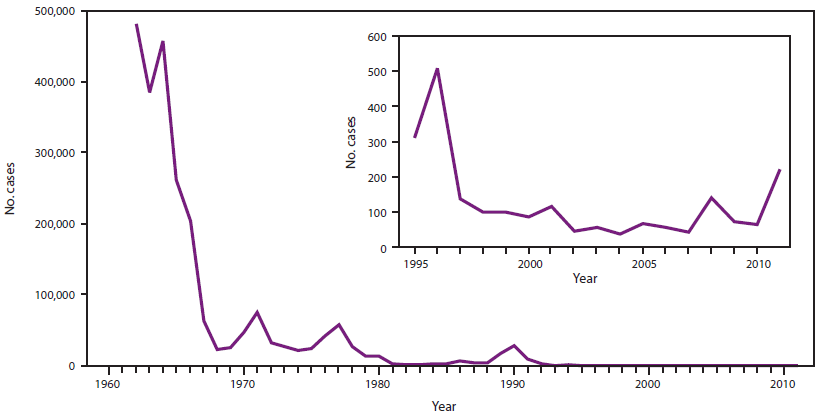
File:Measles Aztec drawing.jpgMeasles used to be a major childhood disease, affecting virtually all children in dramatic periodic outbreaks. The measles virus causes high fever, rash, runny nose, conjunctivitis, and malaise. It can also result in death. In the 1960s a vaccine was developed, and it was ultimately merged into what became the currently-used MMR vaccine. That vaccine helped reduce the incidence of measles to virtually non-existent levels in the US. A recent MMWR depicts the dramatic decrease of disease after vaccine introduction:

This figure provides the number of measles cases in the United States from 1962 through 2011. After the introduction of the 1-dose measles vaccination program, the number of reported measles cases decreased during the late 1960s and early 1970s to approximately 22,000-75,000 cases per year.

Sadly, a 1998 report finding an association between the MMR vaccine and autism led to decrease in the incidence of vaccination and attendant increase in measles disease (inset of the graphic). That study was retracted in 2010 after investigators failed to confirm its findings. Nonetheless, a large number of consumers continue to believe the bogus result that the MMR and other vaccines cause autism and thus forgo vaccinating their children. (There are additional reasons people do not vaccinate their children besides fear of autism; just google "why I'm not vaccinating my child" and you'll get a good sampling of those reasons.)

Recent months have seen continued transmission of measles in susceptible populations across the US, including California and New York City. Why is measles a problem when an effective vaccine is so commonly available? Often, travelers become infected overseas in areas where the prevalence of the measles virus is higher than in the US, and transmit the virus to susceptible individuals (often children) when they return. In NYC, a substantial proportion of the cases appear to be in children too young for the vaccine.

The simple fact is that if people do not have immunity to measles, they are overwhelmingly likely to develop infection and disease following an exposure. This is a highly transmissible virus; estimates of the basic reproduction number, R0, are as high as 18. The high degree of herd immunity in the US limits the size of outbreaks, but, as we see in the current situations in New York and California, transmission occurs due to the presence of unvaccinated persons.

The figure shows the number of U.S residents with measles who were unvaccinated (n = 117), by reasons for not receiving measles vaccine in the United States during January 1-July 13, 2013. Of the 117 who were unvaccinated, 92 (79%) had philosophical objections to vaccination, six (5%) had missed opportunities for vaccination, 15 (13%) occurred among infants aged <12 months who were not eligible for vaccination, and for four (3%) persons the reason for no vaccination was unknown.In the US, all states require children to be vaccinated before starting school. However, depending on the state, children can be exempted from the requirement for medical (notably in transplant patients and those with allergies to vaccine components), religious, or personal belief reasons. Figure 3 (shown here) of a recent MMWR on measles transmission in the US depicts the current reasons for not receiving measles vaccination. Between January and August 2013, most measles cases (82%) were in persons who were unvaccinated. Of those, 79% cited philosophical/religious objections to vaccination as the reason for not receiving the vaccine. Outbreaks related to religious communities are well documented in the news; recent examples include measles in Washington State and British Columbia, measles in New York City, and measles in Texas.

Though this post has focused measles, there are similar issues with other vaccine preventable diseases, including mumps, pertussis, meningitis, and others. Vaccine coverage, both in the US and overseas, must be increased if we are to decrease the incidence of such diseases. We must learn how to more effectively communicate the benefits and risks to those who decide against vaccination.

(image source: first graphic, Wikipedia; second & third graphics, CDC)

Wednesday, February 26, 2014

Raw milk and name calling

I've seen several bumper stickers recently espousing the virtues of drinking raw milk. Although selling unpasteurized milk is illegal in most states, you'll find a virtual counterculture that has rejected pasteurization if you search around the Internet. Depending on the website, there are claims that raw milk alleviates allergies, remedies digestive problems, and reduces susceptibility to asthma.

Many of these sources attempt to justify such views with evidence and logic that few clinicians, microbiologists, or public health practitioners would find compelling. In some ways, such views are akin to those voiced from the anti-vaccine movement: They tend to latch on to the occasional, single study with limited findings as scientific validation of their beliefs, while discounting a substantial scientific literature identifying the risks. The truth is that the practice of drinking unpasteurized milk threatens the health of anyone consuming it, especially children and pregnant women.

It's critically important to understand these views (to the extent possible) and not simply write off the people believing them as belonging to a lunatic fringe and call them dumb and stupid. There are raw-milk advocates who eventually come to realize the risks they are taking and change; isn't it better to understand that process and avoid alienating people who might ultimately do the same?

I am reminded of a BMJ Quality & Safety article about Ignaz Semmelweis and the birth of infection control. At the end there is a passage that discusses the inadvisability of trying to convince people of anything by using insults, public humiliation, and haranguing. In talking to (and about) those who advocate drinking raw milk, we should watch the rhetoric. There's a difference between communicating risk and alienating people. Good risk communication can be effective, whereas alienation probably reinforces the behavior in need of modification.

(image source: David Hartley)