Thursday, January 1, 2015

Follow up: An IGY for medicine

File:International Geophysical Year in 1957.Japanese sttamp of 10yen.jpgHappy New Year to all!

A quick follow up to the recent IGY for medicine post. A colleague in Sierra Leone commented about the post that
The pipe dream is actually happening: it's the Ebola response. In many ways, what you suggest for an International Biomedical Year is exactly what's happening now in West Africa. It's an amazing international effort. The sentiment and organizations are definitely present there, though perhaps the coordination could be improved. That said, if the world NGOs and governmental organizations collaborated like they are for Ebola on other efforts, though more focused as you suggest on research and treatment, a ton could be accomplished.
There's a very positive thought to begin 2015.

Monday, December 29, 2014

Closing the loop on raw milk legislation

Earlier this year I blogged several times about raw milk and the movement advocating drinking it. One of those posts mentioned the Milk Freedom Act of 2014, a bill introduced by Rep. Thomas Massie of Kentucky, which, if passed, would have
Prohibit[ed] a federal department, agency, or court from taking any action that would prohibit, regulate, or otherwise restrict the interstate traffic of milk or a milk product that is unpasteurized and packaged for direct human consumption if such action is based solely upon a determination that because the milk or milk product is unpasteurized it is adulterated, misbranded, or otherwise in violation of federal law.
Just to circle back and check up on the status of the bill, it seems to have gone nowhere. The only echoes that came up in a quick Google search were comments attributed to Massie at a meeting called the "Food Freedom Fest" in September. The comments appear on a food rights and raw milk blog by David Gumpert:
U.S. Congressman Thomas Massie . . . was pessimistic about the chances of actually passing anything in the House of Representatives. Indeed, it isn’t even likely the legislation will get a hearing. “The dairy industry went apoplectic when we introduced the legislation,” he said. “My wife said she didn’t know the lactose industry was so intolerant.” . . . Massie told me after his talk that the best chance to get raw milk legislation through Congress and into law would be as part of some other appropriations bill guaranteed passage. Even that route is a long shot, he said, since not many appropriations bills are likely to get through in the coming year or so.
An alternate interpretation of these comments could be that a bill at odds with the basic tenants of food safety and that would place public health at risk if passed was opposed by corporations who have invested immensely in an infrastructure to deliver safe food. The only way that the bill might get passed is if it piggy backs onto a large appropriations bill, but that probably won't happen because the Congress isn't doing much these days anyway.

So, we can all rest well knowing that the Milk Freedom Act of 2014 will never see the light of day. Thank goodness for a Congress that perfected the art of doing little.

(image source: David Hartley)

Wednesday, December 24, 2014

An IGY for medicine

File:International Geophysical Year in 1957.Japanese sttamp of 10yen.jpgIt's been an interesting first year of blogging, and I want to thank everyone for their helpful input and conversations. It's really been great.

The year 2015 will soon be upon us, bringing with it new opportunities for improving human health across a world fractured with poverty, strife, and war. Robert F Kennedy once said that
There are those that look at things the way they are, and ask why. I dream of things that never were, and ask why not.
This strikes me as an appropriate notion for healthcare and medical research. We should ask "why not?" and "what if?" much, much more often.

A little over 50 years ago an event unfolded that provided both hope for peace and a better understanding of our planet. Lasting for 18 months in 1957 and 1958, it was called the International Geophysical Year (IGY). The idea of an IGY is said to have originated in 1950, at a social gathering in James Van Allen's living room. Someone at the gathering opined that, with the recent development of tools like rockets, radar, and computers, a period of coordinated investigation could make a real impact on understanding the geosphere.

The IGY was thus an attempt to coordinate global research on, and measurements of, the earth, oceans, atmosphere, and sun. The accomplishments of the IGY were legion and included the discovery of the Van Allen radiation belts surrounding the earth; the launch of the first artificial satellites; the charting of ocean depths and ocean currents; and groundbreaking studies of the earth's magnetic field. The IGY required -- and successfully achieved -- international cooperation in a time of significant geopolitical tension. It provided a demonstration of what can be achieved when diverse peoples, who share common and coordinated goals, work together with cutting edge technologies.

Why couldn't we adapt the idea of the IGY and have a future International Biomedical Year, where nations apply tools such as supercomputing, machine learning, and genomic sequencing in a coordinated investigation of the ills plaguing human health? The idea would be to plan collaborative and complementary studies in order to accomplish agreed upon, viable steps toward solutions to important problems.

Admittedly, this is a pipe dream, but why not? What if the world's major government and non-government funding organizations closely coordinated their activities on a truly international, focused initiative? Maybe we could cure one or more cancers, or learn how to cut the incidence of heart disease, or finally understand Alzheimer's disease.

Let's try to ask "why not?" and "what if?" more often in 2015. And may you prosper and be well in the coming year.

(image source: Wikipedia)

Thursday, December 18, 2014

Mumps on ice

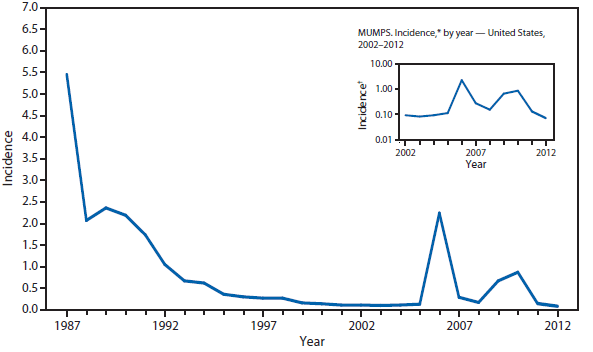
This figure is a line graph that presents the incidence per 100,000 population of mumps cases in the United States from 1987 to 2012The mumps vaccine was licensed in the US in 1967 and recommendations regarding use of the vaccine have varied since its introduction. As described in the CDC Manual for the Surveillance of Vaccine-Preventable Diseases, the Advisory Committee on Immunization Practices (ACIP)
made an official recommendation for one dose of mumps vaccine for all children at any age after 12 months in 1977. In 1989, children began receiving two doses of mumps vaccine because of the implementation of a two-dose measles vaccination policy using the combined measles, mumps, and rubella vaccine (MMR) vaccine. In 2006, a two-dose mumps vaccine policy was recommended for school-aged children, students at post high school educational institutions, healthcare personnel, and international travelers.
Mumps vaccine has had a profound impact on the annual incidence of mumps in the US. In 1968 more than 152,000 cases reported, while in 2003 only 231 cases were reported. Recently, however, the nation has witnessed a resurgence of the disease, and an apparently ongoing outbreak of mumps in the National Hockey League (NHL) illustrates how the mumps virus continues to circulate in the general population. The NHL outbreak has, so far, affected 15 players on five teams, and another three cases are suspected. A timeline of events surrounding the cases suggests the outbreak originated in October.

Doni Bloomfield wrote an article this week (which also contains "mumps on ice" in the title) that, in one vivid passage, illustrates potential infection pathways for mumps virus in professional hockey. Bloomfield quotes James Conway of the University of Wisconsin School of Medicine and Public Health:
You watch these guys taking a big hit up against the boards, there’s snot and boogers and all sorts of stuff flying around as the guy gets hit hard enough, so I don’t think it would surprise me at all that there’s some transmission just by stuff flying around during the games. It’s a sloppy, messy sport.
That's colorful imagery for sure, but in addition to how, it's important to ask why this and other recent outbreaks are occurring. Mumps is, after all, a vaccine preventable disease. 

It's possible that this group of players belongs to a demographic that has lower vaccine coverage, potentially due to parental reticence to vaccinate. However, at least one player is known to have had two doses of vaccine: one childhood dose, consistent with ACIP guidelines in the late 1980s, and another in preparation for foreign travel in February of 2014. Tara Haelle wrote an article recently on the mumps vaccine in which she quotes Paul Offit discussing the rate of waning immunity associated with this vaccine. Offit notes that
If you look at the three [MMR component] vaccines, measles and rubella induce larger memory in B and T cells . . . They have longer lasting immunity. Mumps is the weak sister of the three. You start to see vulnerability 10 years after the first dose and 10 years after the second dose.
Waning vaccine-associated immunity could thus play a role in this outbreak, and in potential future ones as well. Boosters have been used to compensate for waning immunity in past mumps outbreaks. Might a third dose of vaccine be appropriate for the general population at some point in the future?

(image source: CDC)

Thursday, December 4, 2014

The epidemiology of Fearbola

In the mid-19th Century, a newspaper could reach several thousand people daily or weekly. By the mid-20th Century, TV and radio reached 10s to 100s of millions of people instantaneously and possessed a multinational reach. Today, with the Internet, and satellite TV and radio, it is possible to reach 100s of millions of people or more across the globe within minutes. This vast and practically instantaneous reach of technology feeds a seemingly insatiable, 24/7 appetite for news and information. What are the implications of this for fighting epidemics? 

We've seen some of the consequences in the Ebola outbreak this year. On the one hand, the ability of aid groups to spread information broadly has been helpful for raising awareness and bringing additional resources to bear on the epidemic. On the other hand, news headlines resulted in near-hysteria and much counterproductive behavior in the US and other developed nations. Examples were highlighted in a previous post, and many, many others have offered similar observations and commentary.

Perhaps the reactions observed in the US have been understandable, as many ingredients were present for an epidemic of sensationalism and fear: An active public imagination rooted in previous popular books and movies, a government that addressed the issue late and with almost Pollyannaish credibility at first, and a wealth of news outlets offering non-expert commentary while playing to the continuous news cycle.

The resulting epidemic of "Fearbola" should thus not be surprising. It is sobering, however, for it provides a warning for domestic public health agencies: Understand how to administer effective public health messages that are relevant and appealing to the constant clamor of CNN, Fox, and the like, or else risk being drowned out by noise and hype. What if this epidemic had been of a pathogen possessing a short serial interval and high virulence, transmissibility, and R0? The medical system may or may not be prepared, but it seems clear that our risk communication strategies are not. Would the news coverage we saw during the Ebola hysteria in recent months have served the public well if this had been a bona fide threat to US public health?

It's important to understand how the epidemic of fear and hype came into being and propagated so well. I tend to think of messages as themselves being infectious. From that perspective, the ideas that resulted in the hysteria surely had R0 > 1. For ideas related to "dread threats", such as virulent infections with no known cure, is this unavoidable given the high contact rate (e.g., frequency of checking for news and rumors combined with near-constant coverage), short serial internal (e.g., rush to post on social media), broad coverage, and rapid dissemination of modern communications?

If so, we must learn how to craft public health messaging strategies so that authoritative messages will out-compete hype and fear in our hyper-connected world. If we don't learn how to do so, we run the risk that important messages will be drowned out by high-incidence, fearful messages in future outbreaks of international public health importance.

(image source: David Hartley)

Saturday, November 22, 2014

Ebola: Encouraging news but far from victory

The Ebola treatment unit (ETU) in Tubmanburg is the first ETU to be built and staffed by the United States in Liberia / Carol Han, USAID/OFDARecent statistics from West Africa suggest that the epidemic of Ebola virus disease is declining in some areas. While this is welcomed and good news, it's important to remind ourselves that the public health emergency is not over and that significant uncertainties remain. Dr. Joanne Liu, the current president of MSF, described the reasons in an interview with Julia Belluz:
Strictly speaking, when we look at our figures, there is deceleration in the number of cases in a few spots in Liberia and Guinea, but they are still on the rise in Sierra Leone.

There are a few things we need to be conscious about: we have had those decelerations in the past. Basically, it happened while it was spreading in other communities and after that, there was another surge in other hot spots. So we need to make sure it’s an opportunity to consolidate our Ebola isolation centers and case management, strengthen the community information and education. That is key. We need to use this time for that. But the main thing is to not let down our guard.

There’s no room for complacency, no room for mistakes. Every time you go down that path, you pay: you get infected, more people are infected. Ebola does not allow you to make mistakes.
This is certainly true. I think it's also a critical time in another way: With the medical aid in the region and the momentum it is gaining, it would be a shame not to begin asking what will happen when the epidemic is finally conquered. Will the international community simply pull out, leaving a vacuum made more acute by the scores of local healthcare workers lost to Ebola itself? Or, is there a way that the current activity could bolster and influence medicine and public health there for years to come? Some ideas may be creeping into the conversation: US and Liberian officials have decided to reduce the number of Ebola treatment units planned and are discussing spending the money saved on programs aimed at combating future epidemics.

For now, however, we must avoid complacency and remain committed to providing the resources needed to fight the ongoing epidemic. I don't think it's too early to begin conceiving a foundation for improving regional medical and public health capabilities more broadly, however. Perhaps some of the capabilities on site in the affected areas now can be transitioned into a sustainable, effective medical and public health presence at the appropriate time. Not doing so would be a missed opportunity.

(image source: USAID/ Carol Han)

Thursday, November 13, 2014

Influenza vaccine recommendations: Stop needling me!

File:14234CDC Flumist.tifSeasonal influenza is responsible for an estimated 200,000 hospitalizations and 23,000 deaths in the US annually. Each year influenza vaccines are produced based on the viruses forecast to become prevalent. There are two types of vaccine: inactivated influenza vaccine (IIV), delivered via injection, and live attenuated influenza vaccine (LAIV), delivered via a mist sprayed into the nose. Influenza vaccines typically have efficacies exceeding 60% and an estimated 46% of the American public relieves vaccine annually.

While many people are vaccinated each year, it is desirable to increase vaccination rates for at least two reasons. First, vaccine-associated immunity protects individuals from developing potentially serious or fatal disease. Second, high population coverage produces a herd immunity effect: those possessing vaccine-associated immunity cannot become infected and thus cannot infect others. This is especially important for protecting individuals for whom vaccines are contraindicated.

Individuals who are immunocompromised or immunosuppressed are such a group. Consider, for example, patients recovering from hematopoietic stem cell transplantation (HSCT) following myeloablative conditioning. In cases of imperfect donor-recipient match, patients may take immunosuppressive medications as prophylaxis against, or treatment for, graft versus host disease. During this process of immunologic tolerization, which can last months or longer, patients must avoid crowds and limit work/school and social interactions in order to avoid potentially fatal infections. And during this period it is critically important for caregivers and contacts to be vaccinated against influenza and other vaccine-preventable diseases so that they do not become infectious.

LAIV is contraindicated for caregivers of such persons in the Advisory Committee on Immunization Practices (ACIP) guidelines. Because LAIV contains live influenza viruses, a potential exists for transmission of vaccine strain viruses from vaccinees to other persons. The period of viral shedding in vaccinees is variable and relatively short lived. Vaccinated immunocompetent children, for example, shed vaccine viruses for less than 3 weeks, and evidence suggests that shedding may be much shorter lived than that. LAIV-associated shedding occurs in lower titers than is typically observed in disease-associated shedding caused by wild-type influenza viruses.

As several studies have demonstrated higher efficacy of LAIV relative to IIV in children (but see the footnote below), the ACIP has expressed
a preference for the use, when immediately available, of live attenuated influenza vaccine (LAIV) for healthy children aged 2 through 8 years, to be implemented as feasible for the 2014–15 season but not later than the 2015–16 season.
Higher protective efficacy of LAIV in children provides strong rationale for the ACIP statement. Moreover, promoting LAIV as an alternative to IIV in older patient populations may result in increased coverage in those who avoid vaccination due to fear of needles. I wonder if increased use of LAIV might pose additional risk to immunocompromised persons, however, in terms of inadvertent exposure to recent vaccinees shedding live, though attenuated, influenza viruses. Such patients may need to become more meticulous in screening visitors and contacts who may have received LAIV recently.

Footnote: During 2013-2014 there was no measurable effectiveness for LAIV against influenza A (H1N1) among children enrolled in effectiveness studies. The reasons for this are unclear.

(image source: Wikipedia)