
This week the WHO Ebola Response Team published a
paper raising the notion that Ebola could
become endemic in the human population of West Africa. The idea hadn't occurred to me previously, and it struck me as very
unlikely. After all, this is a directly transmissible disease that, as
many have
told us, we know how to control.
After reflecting on the possibility, however, I don't think it
can be discounted out of hand. On the one hand, breaking the chain of
transmission can be achieved theoretically with careful attention to infection
control and prevention practice, which is well defined in the
healthcare environment. On the other hand, this isn't a
nosocomial outbreak. Community transmission is the major driver of
incident cases, so changing human behavior in the community must occur
if this epidemic is to be stopped. In general behavior is hard to affect,
and in this case it may be even harder, given recent
descriptions of distrust between healthcare providers and the community.
As I've
mentioned before, one of the uses of mathematical modeling is to
support clear and careful thinking. In this case,
epidemiologists have applied models to estimate the
basic reproduction ratio,
R0, and have found it to be greater than 1, consistent with estimates from past outbreaks. Such an
R0
suggests that the virus has the potential to circulate permanently in
the human population at some non-zero endemic prevalence. Endemic prevalence levels could be, relatively speaking, high or low (or
intermediate). If low enough, the disease could
fade out stochastically on its own, but at higher prevalences the
continual danger of sporadic cases could persist indefinitely. Models
can help us gain a sense of the relative likelihood of such outcomes.
The
risk factors for acquiring Ebola virus infection are well known. If
effective interventions reducing risky behavior are instituted widely and adhered to, they
may reduce the
effective reproduction ratio,
Reff, to less than 1, thereby
breaking the chain of transmission. Achieving that must entail not only
nosocomial infection control but also infection prevention through behavioral
change in the community.
Changing behavior surely involves building and rebuilding trust between healthcare
providers and local people. I suspect and hope that the
recent massive pledges of, and plans for,
assistance will help build the
necessary rapport and trust. Maybe the
construction of clinic facilities that better support effective care
will help advance such endeavors. One thing is certain, however: the
longer those pledges take to become reality, the more likely the worst scenarios for the course of this epidemic become.
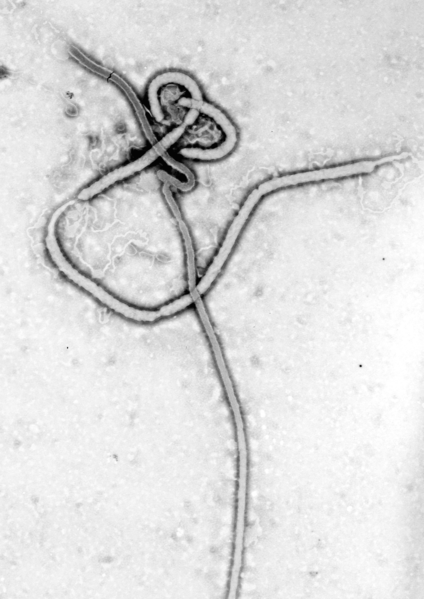
(image source: Wikipedia)
 This week the WHO Ebola Response Team published a paper raising the notion that Ebola could
become endemic in the human population of West Africa. The idea hadn't occurred to me previously, and it struck me as very
unlikely. After all, this is a directly transmissible disease that, as
many have told us, we know how to control.
This week the WHO Ebola Response Team published a paper raising the notion that Ebola could
become endemic in the human population of West Africa. The idea hadn't occurred to me previously, and it struck me as very
unlikely. After all, this is a directly transmissible disease that, as
many have told us, we know how to control. 

