Showing posts with label MMR. Show all posts

Thursday, July 9, 2015

Measles, vaccines, and the herd

https://upload.wikimedia.org/wikipedia/commons/c/c0/Community_Immunity.jpgThe first confirmed measles death in the US since 2003 was recorded in Washington State recently, where a woman died from measles-associated pneumonia. According to a health department news release, she had an underlying condition and was taking medications that suppressed her immune system. People undergoing immunosuppressive therapy are at high risk of contracting infections and, if they develop infection, often do not exhibit the signs immunocompetent persons show. This woman is thought to have become infected at a medical clinic during a local outbreak; the etiology of her pneumonia wasn't recognized as measles until autopsy.

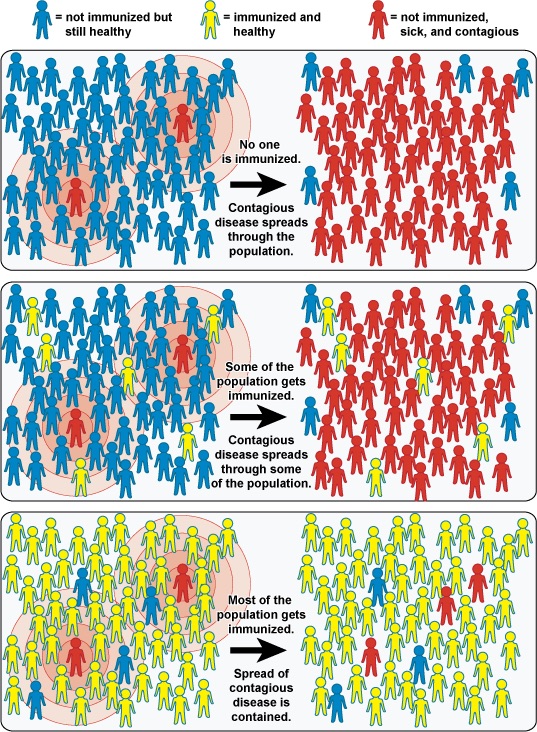
Measles is highly contagious (R0, the basic reproduction ratio of the pathogen, can be as high as 18) and there are hundreds of thousands, if not millions, of immunocompromised persons in the US who depend upon the immunity of those around them for protection. When a large fraction the community possesses immunity to a pathogen, circulation of the pathogen becomes less intense. When the prevalence of immunity becomes high enough, it ceases to circulate. In this simple picture, if the fraction 1–1/R0 of a population can be made immune, and that fraction is maintained over time over time, then a pathogen can be eradicated.

In reality, herd immunity is more complex than this. Many complications arise from imperfect vaccine immunity, population heterogeneity (including network effects), uneven vaccination, and those who opt not to receive vaccines. These complexities make it challenging, from a public health practice perspective, to protect populations with vaccines. Nonetheless, this woman's death illustrates how important it is to immunize as many people as possible: Doing so heightens protection of those vulnerable to vaccine preventable infections.

This case has been reported within the context of anti-vaccination notions, or as I prefer to think of it, vaccine skepticism. Regardless of the terminology, there is one simple truth to the incident: She developed what proved to be a fatal infection because someone in her community was not immune to the measles virus. That seems needless when a safe and effective vaccine that conveys long-lived immunity is available. Hopefully laws like those enacted in California and Vermont recently will spread to other states and help to increase the prevalence of vaccine-associated immunity in communities throughout the US.

(image source: Wikipedia)

Thursday, December 18, 2014

Mumps on ice

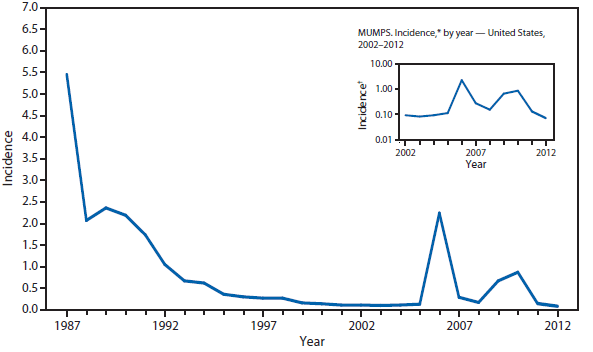
This figure is a line graph that presents the incidence per 100,000 population of mumps cases in the United States from 1987 to 2012The mumps vaccine was licensed in the US in 1967 and recommendations regarding use of the vaccine have varied since its introduction. As described in the CDC Manual for the Surveillance of Vaccine-Preventable Diseases, the Advisory Committee on Immunization Practices (ACIP)
made an official recommendation for one dose of mumps vaccine for all children at any age after 12 months in 1977. In 1989, children began receiving two doses of mumps vaccine because of the implementation of a two-dose measles vaccination policy using the combined measles, mumps, and rubella vaccine (MMR) vaccine. In 2006, a two-dose mumps vaccine policy was recommended for school-aged children, students at post high school educational institutions, healthcare personnel, and international travelers.
Mumps vaccine has had a profound impact on the annual incidence of mumps in the US. In 1968 more than 152,000 cases reported, while in 2003 only 231 cases were reported. Recently, however, the nation has witnessed a resurgence of the disease, and an apparently ongoing outbreak of mumps in the National Hockey League (NHL) illustrates how the mumps virus continues to circulate in the general population. The NHL outbreak has, so far, affected 15 players on five teams, and another three cases are suspected. A timeline of events surrounding the cases suggests the outbreak originated in October.

Doni Bloomfield wrote an article this week (which also contains "mumps on ice" in the title) that, in one vivid passage, illustrates potential infection pathways for mumps virus in professional hockey. Bloomfield quotes James Conway of the University of Wisconsin School of Medicine and Public Health:
You watch these guys taking a big hit up against the boards, there’s snot and boogers and all sorts of stuff flying around as the guy gets hit hard enough, so I don’t think it would surprise me at all that there’s some transmission just by stuff flying around during the games. It’s a sloppy, messy sport.
That's colorful imagery for sure, but in addition to how, it's important to ask why this and other recent outbreaks are occurring. Mumps is, after all, a vaccine preventable disease. 

It's possible that this group of players belongs to a demographic that has lower vaccine coverage, potentially due to parental reticence to vaccinate. However, at least one player is known to have had two doses of vaccine: one childhood dose, consistent with ACIP guidelines in the late 1980s, and another in preparation for foreign travel in February of 2014. Tara Haelle wrote an article recently on the mumps vaccine in which she quotes Paul Offit discussing the rate of waning immunity associated with this vaccine. Offit notes that
If you look at the three [MMR component] vaccines, measles and rubella induce larger memory in B and T cells . . . They have longer lasting immunity. Mumps is the weak sister of the three. You start to see vulnerability 10 years after the first dose and 10 years after the second dose.
Waning vaccine-associated immunity could thus play a role in this outbreak, and in potential future ones as well. Boosters have been used to compensate for waning immunity in past mumps outbreaks. Might a third dose of vaccine be appropriate for the general population at some point in the future?

(image source: CDC)

Sunday, July 13, 2014

Anti-vaccination movement: Nothing new

PHIL Image 14538I've always thought of the anti-vaccination movement as beginning in the aftermath of the bogus (not to mention fraudulent and retracted) 1998 paper associating vaccines with autism. Recently I've become more interested in the movement and have begun reviewing the associated literature. Perhaps what I've found shouldn't surprise me, but in reality I'm astonished: Notions against vaccination have existed for a long time, and date back to at least the British compulsory vaccination laws of the 19th Century.

Jeffrey Baker describes the history of anti-vaccine movements in a very informative paper on the pertussis vaccine controversy in Great Britain in the late 1970s and early 1980s. His study recounts and analyzes how a 1974 series of case reports describing alleged diphtheria–tetanus–pertussis (DTP) vaccine adverse reactions led to plummeting vaccination rates and a resurgence in disease. The study describes many dynamics taking place then that resonate with events surrounding the MMR vaccine recently. For example,
  • Reports of supposed vaccine injuries were published
  • Vaccine victim/anti-vaccine advocacy groups were formed
  • A number of physicians recommending against vaccination emerged as a group
These and other forces led to a sharp decline in public acceptance of the DTP vaccine then in use and an increased incidence of pertussis, the likes of which had not been observed for 20 years (which is another similarity with the current outbreaks of vaccine preventable disease in the United States).

Importantly, Baker hypothesizes that, although the press played a role in initiating the anti-DTP vaccine movement and attendant epidemics, it was not the only factor. He points out that the British medical profession was deeply divided, "reflecting quite real uncertainties surrounding the safety and efficacy of the vaccine in the 1970s." (Note that although the medical profession isn't presently divided on the issue of the MMR vaccine, there is some reason to think that younger doctors are less likely to believe that vaccines are efficacious and safe than more senior doctors are.) Moreover, he notes that
Parents in vaccine victim advocacy groups played an additional important role in sustaining the crisis. The ambivalence of both public and medical profession . . . are best understood against the background of Britain’s long history of skepticism regarding many vaccines dating back to smallpox.
Here, Baker alludes to the controversy surrounding compulsory smallpox vaccination in the late-19th century in the UK, noting that mandatory vaccination against smallpox virus
. . . represented one of the first intrusions of state public health policy into personal life, and consequently provoked considerable libertarian opposition.
Recent studies by Anna Kata of the tactics and tropes used online by the anti-vaccination movement at present, and of anti-vaccination misinformation on the Internet, reflect many facets of the anti-DTP vaccine movement nearly 40 years ago.

How could ideas opposing vaccination have persisted for well over a century? The phenomenon of groups of people opposing the best public health guidance is not limited to vaccination; other examples include the raw milk movement (which refuses to acknowledge the risk posed by bacterial contamination of raw milk and related products) and the anti-fluoridation movement (which questions the safety of fluoridating public water supplies). As I've mentioned before in this blog, it's critically important to understand such groups and how they make behavioral decisions. It may or not be possible to change their outlooks given such knowledge, but it's hard to imagine doing so without it.

(image source: CDC PHIL image ID#14538)