Showing posts with label basic reproduction ratio. Show all posts

Sunday, January 25, 2015

When it comes to measles, it is a small world after all

Dan Diamond wrote an essay recently in Forbes in which he notes the asymmetry of public reaction to Ebola versus measles. He describes how on the one hand, even though Ebola was unlikely to cause an epidemic in the US the public went nuts with Fearbola, while on the other hand measles represents a much more realistic threat of spread but people are somewhat apathetic about it. It seems a valid observation.

It may be difficult to understand public perception of threat when it comes to infectious disease, but, epidemiologically speaking, there are some important differences between the two, as partially summarized in the table below.


Measles Ebola
R0 ~7-18 ~2
Serial interval 8-12 days 5-15 days
Incubation period 10-12 days 2-12 days
CFR 3% 25-90%
Infectious period ~ 4 days before rash to several days after onset of rash At onset of symptoms
Vaccine preventable Yes No

Importantly, persons infected with measles virus are infectious before they begin to feel ill, so they are able to spread the virus in the course of their normal activities. Fearbola -- the epidemic of hyped and often unfounded messages surrounding the threat of Ebola to the US -- struck in part because of the high case fatality rate (CFR) and the lack of a vaccine conveying immunity to the Ebola virus. That contrasts strongly with measles. Even though the measles outbreak that started at Disneyland Resort Theme Parks in California is expanding, I doubt there will be a Fearmeasles epidemic, even though measles can be fatal and cause long term sequelae.

That said, this is a fascinating event due partially to people's attitudes regarding vaccines. Recently, the ramifications of such attitudes, in terms of implications for public health agencies, has been expressed very clearly by Lisa Aliferis (writing for NPR):
Local health officers in counties [in California] affected are busy tracing those who infected patients have been in contact with. Dr. Erica Pan, deputy health officer of Alameda County, says the county has shifted resources from Ebola preparedness to contact tracing for measles. Last year there were four cases of measles in Alameda County, she said, "but we had 400 contacts to investigate."
This is remarkable. On 23 January, the California Department of Health reported that in LA and Orange counties alone there were 31 confirmed cases. A simple back-of-the-envelope calculation suggests that if 4 cases required 400 contacts to be investigated (100 contacts per case on average), then 31 cases could require 3100 contacts to be investigated. No wonder health departments are refocusing resources away from Ebola and onto measles.

People who do not vaccinate their children, or catch up on missed vaccines as adults, do not only place themselves in danger of infection, they place the community in danger. Moreover, they cause scarce public health resources to be spent on controlling a vaccine preventable disease. It's ironic that the lyrics to It's a small world -- the theme song of a ride at Disneyland of the same name -- read
It's a world of laughter, a world of tears.
It's a world of hopes and a world of fears.
There's so much that we share,
That it's time we're aware
It's a small world after all. 
Indeed.

(image source: Wikipedia)

Thursday, December 4, 2014

The epidemiology of Fearbola

In the mid-19th Century, a newspaper could reach several thousand people daily or weekly. By the mid-20th Century, TV and radio reached 10s to 100s of millions of people instantaneously and possessed a multinational reach. Today, with the Internet, and satellite TV and radio, it is possible to reach 100s of millions of people or more across the globe within minutes. This vast and practically instantaneous reach of technology feeds a seemingly insatiable, 24/7 appetite for news and information. What are the implications of this for fighting epidemics? 

We've seen some of the consequences in the Ebola outbreak this year. On the one hand, the ability of aid groups to spread information broadly has been helpful for raising awareness and bringing additional resources to bear on the epidemic. On the other hand, news headlines resulted in near-hysteria and much counterproductive behavior in the US and other developed nations. Examples were highlighted in a previous post, and many, many others have offered similar observations and commentary.

Perhaps the reactions observed in the US have been understandable, as many ingredients were present for an epidemic of sensationalism and fear: An active public imagination rooted in previous popular books and movies, a government that addressed the issue late and with almost Pollyannaish credibility at first, and a wealth of news outlets offering non-expert commentary while playing to the continuous news cycle.

The resulting epidemic of "Fearbola" should thus not be surprising. It is sobering, however, for it provides a warning for domestic public health agencies: Understand how to administer effective public health messages that are relevant and appealing to the constant clamor of CNN, Fox, and the like, or else risk being drowned out by noise and hype. What if this epidemic had been of a pathogen possessing a short serial interval and high virulence, transmissibility, and R0? The medical system may or may not be prepared, but it seems clear that our risk communication strategies are not. Would the news coverage we saw during the Ebola hysteria in recent months have served the public well if this had been a bona fide threat to US public health?

It's important to understand how the epidemic of fear and hype came into being and propagated so well. I tend to think of messages as themselves being infectious. From that perspective, the ideas that resulted in the hysteria surely had R0 > 1. For ideas related to "dread threats", such as virulent infections with no known cure, is this unavoidable given the high contact rate (e.g., frequency of checking for news and rumors combined with near-constant coverage), short serial internal (e.g., rush to post on social media), broad coverage, and rapid dissemination of modern communications?

If so, we must learn how to craft public health messaging strategies so that authoritative messages will out-compete hype and fear in our hyper-connected world. If we don't learn how to do so, we run the risk that important messages will be drowned out by high-incidence, fearful messages in future outbreaks of international public health importance.

(image source: David Hartley)

Saturday, October 11, 2014

Ebola versus influenza and some thoughts on screening

My colleague Eli Perencevich wrote an interesting blog this week in which he discusses airport screening. He points out that some of the discussion surrounding travel restrictions and Ebola are related to ideas from (and models of) epidemics of respiratory viruses, including the 2009 H1N1 pandemic. In the post he highlights some of the important differences between Ebola and influenza:
. . . Ebola is slower moving, has a much longer incubation period (especially compared to the duration of a transcontinental flight), and is not contagious before symptoms develop. What does this mean? It means that if Ebola was as infectious as influenza, millions would have already died - apocalypse. It also means that since Ebola is not transmissible during its long incubation period, it may be possible to quickly isolate patients when symptoms develop. Thus, airport screening on exit or entry could limit transmission and perhaps through early diagnosis allow Ebola infected patients to receive life saving treatment more quickly. 
Later in the post he highlights the need for mathematical model-based analysis of the impact of specific Ebola screening programs. I recommend reading the blog.

As I mentioned in a comment to the piece, in addition to incubation period, it's useful to consider the serial interval (the period between infection and transmission; sometimes also referred to as the generation interval or generation time) and basic reproduction ratio (R0). As discussed before, estimates for R0 for Ebola in this event are similar to estimates of R0 for pandemic influenza events. White and Pagano estimate the serial interval for a 1995 outbreak of Ebola in Congo to be 5.4-7.6 days and the WHO Ebola Response Team estimates the serial interval for the current epidemic to be near 15 days. By comparison, estimates of the serial interval for the 2009 pandemic of influenza fall in the range of 2.5-3.0 days. Ebola has much longer serial intervals than does influenza.

What do we take away from this? One thing is that the serial interval is important for understanding the speed of spread. Perencevich observes that
. . . the first case of Ebola is thought to have occurred 307 days ago on December 6th in a two-year old boy. Since that time there have been an estimated 8,032 cases (granted these could be underestimates). If you compare a similar 307-day period for 2009 H1N1, April 12, 2009 to February 12, 2010 CDC estimated that between 42 million and 86 million cases occurred in the US with a mid-level estimate of 59 million people infected. Think about that -- 7,300 times more cases of H1N1 using the mid-level estimate during the same 307 days.
It's clear, then, that equating influenza and Ebola on the basis of R0 alone is misleading. Thinking of R0 as a reproductive factor for each generation of infection (at the beginning of an epidemic in a susceptible population) and the serial interval as how rapidly generations of infection occur, however, it becomes clearer that the much shorter serial interval of influenza is related the explosive emergence of influenza cases in 2009-10 relative to Ebola in 2013-14, despite the similar R0 values. It's more complex than this in reality; Wallinga and Lipsitch present a detailed mathematical treatment of how generation intervals shape the relationship between epidemic growth rates and reproductive numbers, and Lipsitch et al illustrate, within the context of SARS, how incubation period, serial interval, and epidemic growth rate combine to produce estimates of R0.

Another thing to ponder is that longer serial intervals can, depending on the length of the incubation period, give more time to institute control measures. On the one hand, the long serial interval relative to incubation period in the case of Ebola may suggest a higher likelihood of detecting an infectious traveler in an airport than there is for influenza. On the other hand, the extremely low incidence of Ebola in passengers must also be considered; it may not be an efficient activity to devote resources to.

I agree with Eli that mathematical models can help shed light on such questions. Perhaps such models have been published, I admit to falling behind on the mathematical epidemiology of Ebola results in the last two weeks. 

(image source: David Hartley)

Friday, September 26, 2014

Epidemiology and behavior in the time of Ebola

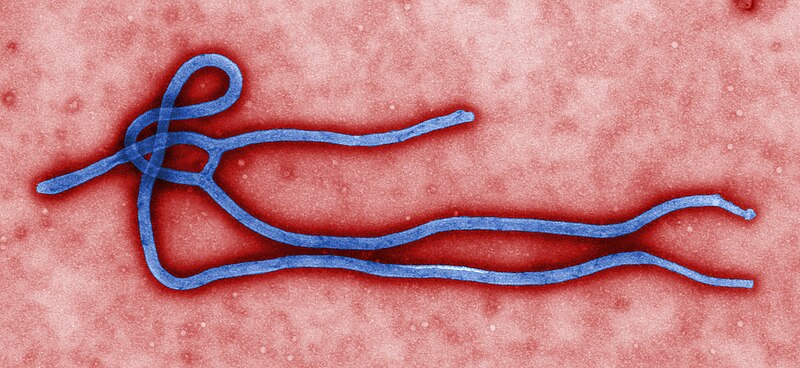
File:Ebola virus em.pngThis week the WHO Ebola Response Team published a paper raising the notion that Ebola could become endemic in the human population of West Africa. The idea hadn't occurred to me previously, and it struck me as very unlikely. After all, this is a directly transmissible disease that, as many have told us, we know how to control.

After reflecting on the possibility, however, I don't think it can be discounted out of hand. On the one hand, breaking the chain of transmission can be achieved theoretically with careful attention to infection control and prevention practice, which is well defined in the healthcare environment. On the other hand, this isn't a nosocomial outbreak. Community transmission is the major driver of incident cases, so changing human behavior in the community must occur if this epidemic is to be stopped. In general behavior is hard to affect, and in this case it may be even harder, given recent descriptions of distrust between healthcare providers and the community.

As I've mentioned before, one of the uses of mathematical modeling is to support clear and careful thinking. In this case, epidemiologists have applied models to estimate the basic reproduction ratio, R0, and have found it to be greater than 1, consistent with estimates from past outbreaks. Such an R0 suggests that the virus has the potential to circulate permanently in the human population at some non-zero endemic prevalence. Endemic prevalence levels could be, relatively speaking, high or low (or intermediate). If low enough, the disease could fade out stochastically on its own, but at higher prevalences the continual danger of sporadic cases could persist indefinitely. Models can help us gain a sense of the relative likelihood of such outcomes.

The risk factors for acquiring Ebola virus infection are well known. If effective interventions reducing risky behavior are instituted widely and adhered to, they may reduce the effective reproduction ratio, Reff, to less than 1, thereby breaking the chain of transmission. Achieving that must entail not only nosocomial infection control but also infection prevention through behavioral change in the community.

Changing behavior surely involves building and rebuilding trust between healthcare providers and local people. I suspect and hope that the recent massive pledges of, and plans for, assistance will help build the necessary rapport and trust. Maybe the construction of clinic facilities that better support effective care will help advance such endeavors. One thing is certain, however: the longer those pledges take to become reality, the more likely the worst scenarios for the course of this epidemic become.

(image source: Wikipedia)

Tuesday, September 2, 2014

Why model infectious disease: Ebola

Several weeks ago I wrote a blog on why modeling infectious disease is useful. Now seems like a good time to highlight a few issues regarding "why model?" within the context of the current Ebola event. Science Insider recently published a very nice piece on Ebola modeling and some initial results from different groups working the issue. Discussing the article with a few colleagues who are not modelers, however, I sensed some skepticism regarding the past track record of models and why it's useful to model this outbreak.

As described by many authors previously (see the links in the previous blog), a major use of modeling is to help researchers think carefully about a problem. That's especially true in the current situation, where models can help analyze complex issues. A few examples include:
  • What can be derived from data in hand, or data that can be collected, to improve our ability to clarify the situation? 
  • Can we infer how quickly the virus is being transmitted and whether it is decreasing, increasing, or staying the same (questions regarding the basic reproduction ratio, R0, and the effective reproduction ratio, Reff)?  
  • If vaccines become available, what coverage and efficacy might be necessary to control the outbreak (i.e., reduce Reff below 1)? What vaccination strategies are likely to make optimal use of resources?
  • Are there combination interventions that might prove effective at reducing the incidence of infection? 
  • What is the likelihood of Ebola cases arriving in distant nations via air travel
In short, there are plenty of questions that modeling can help elucidate.

One should be skeptical about any epidemiologic method, including mathematical and computer modeling, when the stakes for public health are so high. Ultimately, however, policymakers need timely and defensible analytic guidance to support allocation of scarce resources. Modeling is one component of such guidance.

(image source: David Hartley)

Friday, August 29, 2014

Nowhere is it written that dangerous pathogens must have high basic reproduction ratios

As discussed previously, there are lessons aplenty to learn from the ongoing Ebola outbreak in West Africa. One simple lesson is this: Even with a low basic reproduction ratio (symbolized mathematically as R0), a pathogen can still spread widely under the right conditions.

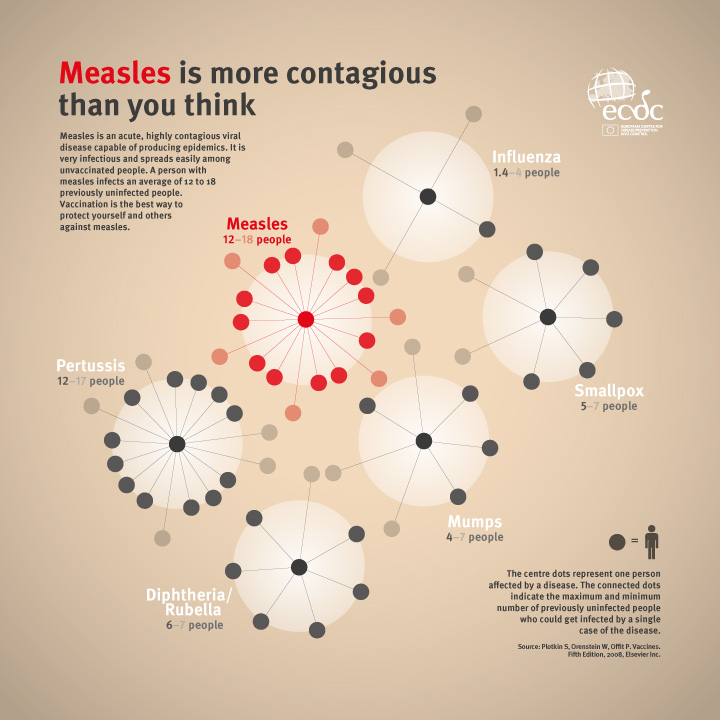
Current estimates of the basic reproduction number for this Ebola outbreak are roughly in the range of 1.3-2.5. That's pretty modest when compared with other notorious agents. Estimates of R0 for smallpox outbreaks, for example, were typically 4-10 and those for cholera epidemics can be in the range of 3-12. Measles outbreaks can have R0 values of up to 18.

R0 itself is sometimes thought of as a surrogate for "epidemic potential". Certainly, and by definition, pathogens with high R0 spread quickly, whereas pathogens with lower R0 don't. Does this mean that pathogens possessing relatively low values of R0 have lower potential to harm public health?

Certainly not. In fact, pandemic influenza viruses, for example, often fall in the range 1.5-2.0. Pathogens associated with lower values of R0 can spread widely if control efforts are not effective. In the case of pandemic influenza, control measures include vaccination and handwashing. In the current Ebola situation, due to a range of social, economic, and political factors, it has been difficult to implement widespread, effective control measures. The infection has thus spread and will likely continue do so in the region.

Does this have implications for other infections? It absolutely does. One could imagine some theoretical pathogen, for example, that is spread predominantly by hands (call it "pathogen X") and that is not killed by alcohol based hand rub (ABHR). Then, in circumstances where ABHRs are used in place of handwashing, one might imagine that pathogen X could, over time, become widely prevalent, even if it does not possess a high R0. Pathogen X might be similar to Clostridium difficile; one estimate of R0 for C. difficile is in the range 0.5-1.5.

For this reason, we should not think only in terms of R0 for classifying pathogens as dangerous or not. While high R0 pathogens spread quickly, leaving little time to react and take action, Ebola in West Africa this year demonstrates that a pathogen possessing a more modest R0 can result in a dangerous public health situation. 

There's a story, which is possibly apocryphal, that Enrico Fermi once remarked that nowhere is it written that the laws of physics must be linear. I think there's an analogue that should be kept in mind in infectious disease epidemiology: Nowhere is it written that dangerous pathogens must have high R0.

(image source: ECDC

Thursday, July 31, 2014

Ebola: Thoughts on a public health disaster

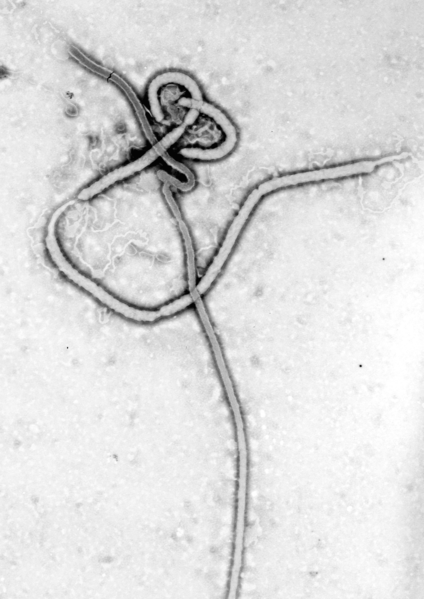
File:Ebola virus virion.jpgThe current outbreak of Ebola hemorrhagic fever in western Africa has been ongoing for months. It is a remarkable and tragic event. Sadly, there is no known cure, the case fatality proportion is high (historically 50-90%), and prevention is difficult in the areas where the virus is currently spreading.

Nations outside Africa are now recognizing the possibility of Ebola-infected travelers returning home. Importation of disease is a public health issue for other infections, such as measles, outbreaks of which are commonly sparked by visitors returning from areas where cases are prevalent. In the case of Ebola, one traveler died on the last leg of a West African trip, before returning home to Minnesota, so there's good reason to believe that importation could occur. It's probably unlikely, however, given the current level of awareness. Some African airlines, for example, have curtailed air service in affected areas and are screening passengers for signs of illness. International guidance on passenger screening is being evaluated as well. Moreover, CDC has issued interim guidance regarding Ebola for airline flight crews, cleaning personnel, and cargo personnel.

If an infected or infectious traveler does return, is it unlikely to result in the dramatic transmission currently observed in Africa. The current heightened awareness makes it very likely that travelers returning from affected areas would be evaluated for possible Ebola infection should they develop illness and present to a healthcare provider. The CDC has issued guidance advising healthcare workers to
be alert for signs and symptoms of EVD [Ebola virus disease] in patients with compatible illness who have a recent (within 21 days) travel history to countries where the outbreak is occurring, and should consider isolation of those patients meeting these criteria, pending diagnostic testing. 
Infection control procedures are standard and the necessary supplies are plentiful in Western hospitals, making it unlikely that an Ebola patient would cause secondary infections in healthcare settings.

Moreover, Ebola virus is much less transmissible than many other viruses. Measles virus, for example, has basic reproduction ratios in the range of 11-18, whereas those for Ebola have been estimated to be between 1-2. For comparison, the basic reproductive ratio for influenza is estimated to be 3-4, for rubella 6-7, and for chickenpox 10-12. The ratio for pertussis is similar to that of measles. One wonders what the basic reproduction ratio is for the current outbreak in Africa is (and if analytic approaches using social media might be helpful for estimating it).

Given that the current outbreak is so large compared to past outbreaks of Ebola, we might learn some lessons about this exotic disease. For example, are there transmission pathways that we don't know of at present? Aerosol transmission is thought to play only a minor role if any in transmission of human strains of Ebola virus, but perhaps new information will emerge from future epidemiological studies of the current outbreak.

What is for sure is that the events in Africa are a tremendous human tragedy. I hope that the desperate measures of closing schools and nonessential government services will help to control the spread of the virus. It isn't clear that it will.

(image source: Wikipedia)