Friday, April 17, 2015

HAI and aliens: The Drake equation in epidemiology

File:NASA-Apollo8-Dec24-Earthrise.jpgIn a 1961, Frank Drake introduced the following equation for the number N of civilizations in our galaxy with which radio-communication might be possible,
N = R x Fp x Ne x Fl x Fi x Fc x L
As described by the SETI institute,
  • R is the average rate of star formation in the galaxy, 
  • Fp is the fraction of those stars that have planets, 
  • Ne is the average number of planets that can potentially support life per star that has planets, 
  • Fl is the fraction of planets that could support life that actually develop life at some point, 
  • Fi is the fraction of planets with life that actually go on to develop intelligent life (civilizations), 
  • Fc is the fraction of civilizations that develop a technology that releases detectable signs of their existence into space, and 
  • L is the length of time for which such civilizations release detectable signals into space. 
Drake's purpose in writing this equation was to facilitate discussion at a meeting. Its importance is not the numerical prediction of communicative civilizations in the galaxy (note there are 7 factors in the equation and errors in each term will combine to make any calculation wildly uncertain) but rather in the framing of issues related to the search for alien life. That said, the equation tells a story. Assuming that these are the relevant factors, then if any the terms are zero, N is zero and we are likely to be alone. If none of them are zero, then even if they are exceedingly small, there is a chance that there is life somewhere in the galaxy. Moreover, it's unlikely that any of these terms are zero, given the huge size of the galaxy. In epidemiological terms, then, the equation helps to frame our thinking about the potential prevalence of life in the Milky Way galaxy.

Given that NASA opined recently that we're likely to have strong indications of life beyond Earth within a decade, it made me wonder about Drake-like equations in medicine and epidemiology. As a toy example, suppose that we write the number of patients contracting hospital-acquired infections (HAIs) yearly in the US as the product of several factors, say
N = Nhospital visits x Pcontact x Pdevelop disease x Pdisease reported
where
  • Nhospital visits is the number of patients visiting hospitals annually,
  • Pcontact is the probability that a patient comes into contact with infectious material (e.g., via environmental contamination or an infectious patient or HCW)
  • Pdevelop disease is the probability of developing disease if infected, and 
  • Pdisease reported is the probability that an infection is recognized and reported.
According to the CDC, there are 35.1M hospital discharges annually in the US, so Nhosp visits~35M. Now suppose that Pcontact and Pdevelop disease are both low, say 1% , and that we have excellent surveillance so that Pdisease reported ~1. If that could be true, then we would expect to see 3,500 HAI per year. We should be so lucky. Being more realistic, however, might yield a 10% change of coming into contact to infection, Pcontact~0.1, and a higher probability of contracting disease if infected, say 50%, so that Pdevelop disease ~ 0.5. In that case we get N=1.75M HAI annually, which is close to the CDC estimate of 1.7M.

How could this be decreased? The number of hospital visits, N, is unlikely to decrease drastically, so that's not really a control variable. Perhaps we could develop interventions to decrease Pcontact and Pdevelop disease. Obviously there is tremendous focus on reducing Pcontact through handwashing, alcohol based had rubs, contact precautions, better environmental cleaning, etc already. If Pcontact could be reduced by a factor of 10, from 0.1 to 0.01 -- seemingly a tall order -- N could be dropped to 175K. That may not be possible, but suppose we could achieve a factor of 2 improvement so that Pcontact ~ 0.05. If we could combine that with a similar decrease in Pdevelop disease by, say, better use of antimicrobials, then N could in turn fall from 1.7M to 438K. Thus, combination strategies could have great impact.

This is simply a back of the envelop calculation: the equation above is but an approximation and the estimates are completely arbitrary. Moreover, parameters will vary from facility to facility and even between patient populations (imagine how Pdevelop disease is likely to vary between transplant versus general surgery patients). That said, this toy model illustrates a simple point: Breaking a problem down into smaller pieces can be helpful in thinking about it.

While this way of thinking is not alien (pun intended) to biostatistics and epidemiology, and clearly has limitations, I think it's helpful for framing issues in one's mind. In addition to clearly laying out assumptions in whatever is being contemplated (in this case, HAI), toy model approaches can suggest what may be needed in order to get a better answer.

(image source: Wikipedia)

Saturday, April 4, 2015

The information tsunami: Riding versus drowning

File:Great Wave off Kanagawa2.jpgA few things have come across my Twitter feed in recent weeks that relate to cognition and the Internet. The first is an article by Thomas Erren et al on 10 elements of lifelong learning according to Richard Hamming. I'm a big fan of Hamming's ideas and research philosophy, and the authors do a nice job of updating some important points from his book. I recommend reading the paper; to wet your appetite, the first two rules they describe include
Rule 1. Cultivate Lifelong Learning as a “Style of Thinking” That Concentrates on Fundamental Principles Rather Than on Facts
Rule 2. Structure Your Learning to Ride the Information Tsunami Rather Than Drown in It
These strike a chord when thought about in the context of the recent study by Barr et al, which suggested that smartphones, as entrée to vast stores of information, can supplant critical thinking by making it easy for people to offload thinking to technology. Hamming, Erren et al, and Barr et al collectively remind us of the dangers of merely looking for facts on the Internet as opposed to concentrating on forming a coherent body of knowledge out of those facts.

Eric Topol captures this perfectly in a recent tweet:
The future of medicine is not about looking things up on the Internet; it's being able to generate one's own real world data+super-analytics
I couldn't agree more. Data and "super-analytics" need to be aimed at generating and conveying a coherent picture of health so that consumers of those analytics -- whether researchers, physicians, or non-specialists -- are informed and educated.

As the sea of facts gets larger and more accessible, becoming a tsunami, we face the risk of drowning, as Erren et al suggest, or becoming cognitively lazy, as Barr et al suggest. How do humans synthesize knowledge from data, especially when the data may be messy, variable, or uncertain? In the case of public health, the issue is hugely important, because people will synthesize their own knowledge based on facts they find compelling (e.g., the University of Google, "My science is named Evan"). How do we leverage the information superhighway to produce insight and decisions grounded in the relevant facts?

(image source: Wikipedia)

Sunday, March 22, 2015

The digital epidemiology of Staphylococcus aureus

File:Staphylococcus aureus 01.jpgDigital epidemiology encompasses an emerging set of analytic techniques and approaches to data collection. Data in these studies are almost always born digital -- they are not recorded or transcribed by hand -- and often the research involves online networks in one guise or another. While these methods are being utilized increasingly, studies combining both digital network data and microbiological data on the spread of hospital associated pathogens have, so far as I know, been missing. 

Obadia et al have published an exemplary study doing just this for the case of MRSA and MSSA in a long term care center. Many researchers have in the past adopted a very reasonable and plausible hypothesis regarding the spread of staph in hospitals: namely, that it depends to a large extent upon person to person contact. If that's true, then obviously the ways in which patients and healthcare workers (HCWs) interact with one another, i.e., the patient-patient and patient-HCW contact networks, must be important for understanding spread. To my knowledge, until this study, nobody has really documented this with clarity at the individual level.

Obadia et al have illustrated this relationship between staph infection and contact network structure quite clearly by utilizing wireless proximity sensing and spa typing. They demonstrate how to employ digital technology to measure who interacts with whom, how frequently, and for how long, over long periods of time, and how to combine that data with microbiological surveillance in order to observe how transmission depends on the web of contacts in a facility. The authors found that close proximity interaction (CPI) paths existed between those colonized with like staph strains, and that those path lengths were significantly shorter than paths between random pairs in the study population. This is in agreement with what is expected from the transmission hypothesis. Their study also highlighted the importance of HCWs as links in the chain of contacts between infected patients.

One important implication of this work is that it might be possible to prevent infections by managing and monitoring close contact paths between patients and patients and between HCWs and patients. The approach may also be useful for developing targeted surveillance strategies that can detect spread and break the contact pathways most likely to result in further spread. I recommend reading the paper, and also the excellent comments regarding it by Eli Perencevich at the Controversies in Hospital Infection Prevention blog.

Overall, I think this study is a great illustration of the power of digital epidemiology methods for gathering detailed data in order to understand how disease is spread in the real -- as opposed to the simplified, theoretical -- world. We need more like it to inform both our thinking about hospital associated infections and analytic models of such pathogens.

(image source: CDC)

Saturday, March 14, 2015

The calculus of online credibility

It's been estimated that roughly one quarter of the global population will soon be using smartphones. Recently, Nathaniel Barr et al have studied how the instant and ubiquitous access to information from smartphone use is impacting our propensity for critical thinking. The paper's abstract captures the issue:
With the advent of Smartphone technology, access to the Internet and its associated knowledge base is at one’s fingertips. What consequences does this have for human cognition? We frame Smartphone use as an instantiation of the extended mind—the notion that our cognition goes beyond our brains—and in so doing, characterize a modern form of cognitive miserliness. Specifically, that people typically forego effortful analytic thinking in lieu of fast and easy intuition suggests that individuals may allow their Smartphones to do their thinking for them. Our account predicts that individuals who are relatively less willing and/or able to engage effortful reasoning processes may compensate by relying on the Internet through their Smartphones. . . . These findings demonstrate that people may offload thinking to technology, which in turn demands that psychological science understand the meshing of mind and media to adequately characterize human experience and cognition in the modern era.
Tania Lombrozo, writing for NPR, put it more succinctly:
We all know a little knowledge can be a dangerous thing. Research increasingly supports a related proposition — that easy knowledge can be a dangerous thing.
I don't want to go into the strengths and weaknesses of the study, or it's ability to assess causality. Researchers will no doubt address these important issues in time, and Lombrozo discusses them nicely in her essay. However, it's important to contemplate some of the implications of the study.

One implication is that, as the Internet and mobile technology have changed the way we acquire information, they have also changed the way in which we assess its credibility. We've all seen people read claims and discussions from different online media and rapidly accept them as true. Sometimes the information they glean is true -- online communities of people possessing similar interests and expertise are often rich sources of specialized information -- whereas other times online discourse is not so authoritative. Regardless, acceptance of what surfers read is often rapid. If people increasingly rely on digital information and forgo complex, analytic thinking -- the "cognitive miserliness" that Barr et al describe -- perhaps it's because they trust what they're reading.

If true, what are the implications for public health? Insofar as health behavior is influenced through online information gathering, we must understand how people determine trust and credibility of online information. Professional achievement in terms of academic degrees, certifications, or job titles of those publishing information online may be important, but also important are a source's online profile in terms of site appearance and ease of navigation, number of followers, and number of page views. In fact, the latter may be more important than the former.

If it's true that we are increasingly putting our brains in our pockets and avoiding critical thinking, as Barr et al suggest, then it's important to understand the calculus of credibility in cyberspace. If people find Facebook, Reddit threads, and Fox News more credible than the CDC or their own doctor -- rightly or wrongly -- we had better understand why and engage it as a tool.

(image source: David Hartley)

Tuesday, February 24, 2015

Vaccines: What do we think?

2015 measles cases in the U.S., January 1 to February 20, 2015. Map of the U.S. indicates in shades of light to dark blue the number of cases. Twelve states (Colorado, Delaware, Georgia, Michigan, Minnesota, Nebraska, New Jersey, New York, Pennsylvania, South Dakota, Texas, and Utah) and the District of Columbia have 1 to 4 cases. Three states (Arizona, Nevada and Washington) have 5 to 9 cases. One state (Illinois) has 10 to 19 cases and one state (California) has 20 or more cases. These are provisional data reported to CDC’s National Center for Immunization and Respiratory Diseases.CNN published a poll on Monday of this week that contains some interesting statistics. A story announcing the poll began
A new CNN/ORC poll shows nearly 8 of 10 Americans believe parents should be required to vaccinate their healthy children against preventable diseases such as measles, mumps, rubella and polio. If the children are not vaccinated, most agree the child should not be allowed to attend public school or day care . . . 
The basic methodology and results are described here. Overall, 78% of respondents believed parents should be required to vaccinate children against preventable diseases if they are healthy. The age stratified results depict an interesting trend: Older Americans are most supportive of required vaccinations (84% of those 50+ versus 72% of those under 50) and those at the younger end of the spectrum -- and in particular, those of common childbearing ages -- are much less supportive (only 67% of those 18-34 years of age).

Pondering these statistics might lead one to muse that it would have been useful if the poll, rather than asking if parents should be required to vaccinate, had instead asked simply if parents should vaccinate. On Tuesday another poll appeared, this time by Reuters/Ipsos, that asked just that. Information on that poll can be found here. A Reuters news story summarized this poll:
Seventy-eight percent of respondents in the online survey said all children should be vaccinated unless there is a direct health risk to them from vaccination. Only 13 percent opposed vaccinations. . . 
The story went on to note that the "numbers are absolutely overwhelming in favor of vaccinations with a consistent minority in opposition." That's good, but probably not good enough. Herd immunity likely needs to be over 90% in order to eliminate measles. If the poll was representative of the larger US population, then the 78% statistic suggests that we have some work to do.

Of course, polls are not compete studies, and it's hard to know what to make of such results. However, I don't think they're entirely reassuring.

(image source: CDC)

Thursday, February 5, 2015

Elimination, not eradication

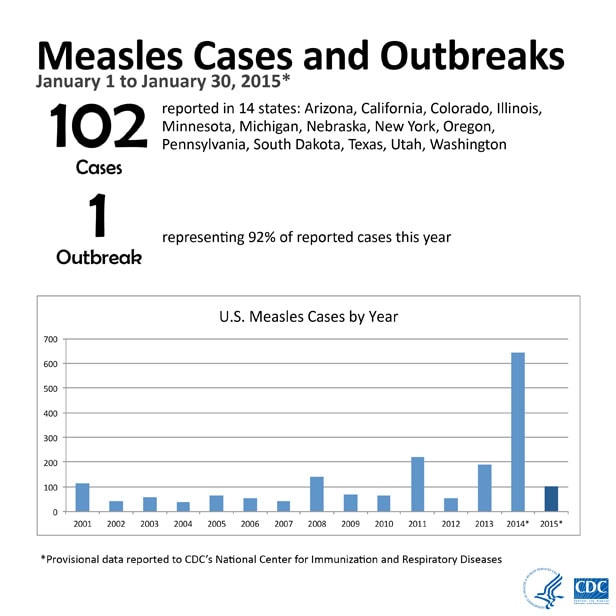
Measles cases and outbreaks from January 1-November 29, 2014. 610 cases reported in 24 states: Alabama, California, Connecticut, Hawaii, Illinois, Indiana, Kansas, Massachusetts, Michigan, Minnesota, Missouri, Nebraska, New Jersey, New Mexico, New York, Ohio, Oregon, Pennsylvania, Tennessee, Texas, Utah, Virginia, Wisconsin, and Washington. 20outbreaks representing 89% of reported cases this year. Annual reported cases have ranged from a low of 37 in 2004 to a high of 220 in 2011In discussions of past and present measles activity in the United States, one sometimes reads that measles was once eradicated here.

It wasn't, though in 2000 it was declared eliminated.

Measles elimination is defined as interruption of continuous (i.e., endemic) transmission lasting ≥12 months. Eradication, on the other hand, implies global elimination. Smallpox was declared eradicated in 1980 and we're trying hard to eradicate polio and others at present. Measles has not been eradicated.

Eradication of measles may be possible, though there significant challenges. Sadly, despite the availability of a safe and effective vaccine, the disease continues to maintain a strong foothold in many regions of the globe. This persistence poses a threat to non-immune persons in our mobile world, as we are currently seeing in the US.

If you hear someone confuse elimination for eradication, you might gently correct them. It's important that people understand the threats to their health and wellbeing. 

(image source: CDC)

Sunday, February 1, 2015

Your belief does not trump his right to recover

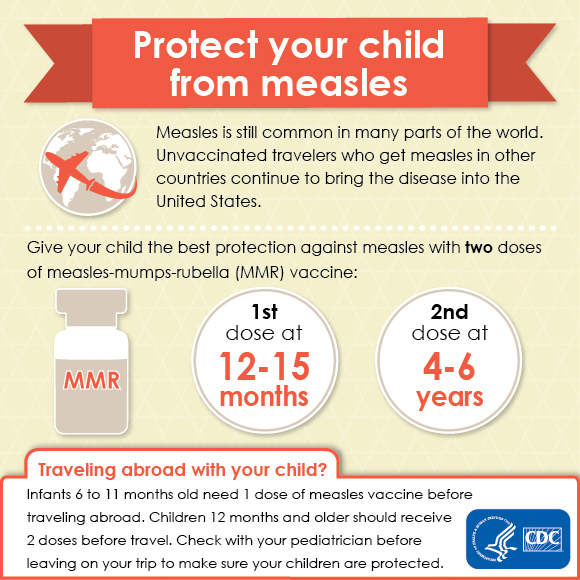
Infographic: Protect your child from measles. Measles is still common in many parts of the world. Unvaccinated travelers who get measles in other countries continue to bring the disease into the United States. Give your child the best protection against measles with two doses of measles-mumps-rubella (MMR) vaccine: 1st dose at 12-15 months, 2nd dose at 4-6 years. Traveling abroad with your child? Infants 6-11 months old need 1 dose of measles vaccine before traveling abroad. Children 12 months and older should receive 2 doses before travel. Check with your pediatrician before leaving on your trip to make sure your children are protected.One story connected to the California measles episode in particular speaks to me. It concerns a dad speaking out, in defense of his son's fragile health, against the decisions of many not to vaccinate their children. The man's son is recovering from leukemia and cannot yet be vaccinated against measles. He is justifiably concerned about unvaccinated classmates posing a potentially mortal infection risk to his son and has requested that such children be barred from school.

The question of why some don't vaccinate their children (or themselves) is complex and multifaceted, but it seems to have one thing in common with other major public health issues of recent times: the idea that "it's my right to". In addition to it's my right to not vaccinate my children, we often hear that it's my right to possess assault rifles and it's my right to have raw milk on the market.

Should these be individual rights? From a public health perspective I would argue no, and point out that there's another fundamental question to be answered: Do we want to live in a society where someone's "rights" endanger the health and wellbeing of others? We've answered that question before for other major public health issues: there are mandatory seat belt laws in many states; it's not legal to drive under the influence of alcohol; and it's not legal to smoke in public areas in many parts of the nation. Such laws attempt to limit the ability of an individual to place others at risk. The dad in California has the right -- in fact, the obligation -- to protect his son's health and wellbeing. Could enacting legislation mandating vaccination except in specific medical circumstances be a solution?

I resonated with the man's concern for his son partially because cancer has touched the lives of close friends of mine. Those at risk from infection due to therapy-related immunocompromise and chronic disease are thought to number in the millions in the US. They have rights and deserve to be protected. Legislation on this issue, if possible, won't happen quickly. Pragmatically, I think we need to understand why some people believe that vaccines are dangerous when there's no evidence to support that claim and much evidence demonstrating that measles -- and other vaccine-preventable preventable diseases -- are lethally dangerous. Why are the likes of Jenny McCarthy more credible to some than the US Institute of Medicine? Understanding such issues may provide a basis for a conversation and, ultimately, change.

(image source: CDC)